
 1 week ago
11
1 week ago
11
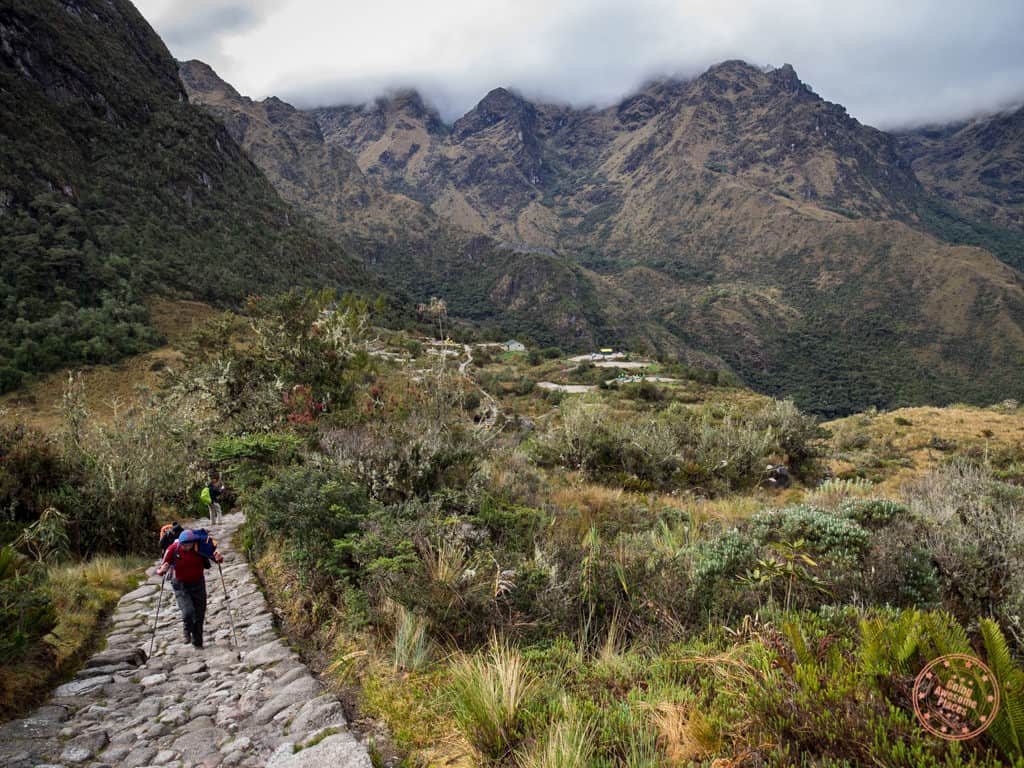
So, you’ve decided to hike the legendary Inca Trail and finally lay eyes on Machu Picchu. You’re buzzing with excitement — maybe you’ve even booked your flights — but when it comes to planning, it all feels a bit overwhelming. We get it. we’ve been there.
This article may contain affiliate links where we make a small commission for purchases you make from links that you click from this article. By purchasing through our links, you support us at no additional cost. Thank you for your support ❤️. For more details, read our disclosure page.
When we first did the trek with Alpaca Expeditions, we had no idea where to start. Ironically, the hardest part isn’t the lack of information — it’s that there’s too much out there. That’s why we originally put together this Inca Trail hiking guide: to make sense of it all and share every lesson, tip, and must-know detail from my own experience. This is an exhaustive list of EVERYTHING.
This is everything that we wish someone had told me before going. It’s also everything that we told myself to write down because we knew we’d forget.
While the trek itself was a few years ago, this guide has now been fully updated with the most accurate and up-to-date 2026 information — from permit rules and itinerary updates to packing tips and booking advice.
Keep in mind throughout this that our trip to Peru included the Amazon Rainforest but in order to keep things focused, this article focuses entirely on the classic 4-day, 3-night Inca Trail, the most iconic route to Machu Picchu. If you’ve ever wondered what to expect, how to prepare, and how to make the most of it, you’re in the right place.
Get ready to plan like a pro — and yes, stick around until the end for a special discount on Alpaca Expeditions. Let’s go!
What You’ll Get Out Of This Article
If you’re ready to tackle the legendary Inca Trail but don’t know where to start, this guide is for you. From booking your trek with a trusted tour company like Alpaca Expeditions to understanding what to pack, when to go, and how to prepare for the altitude — it’s all here.
You’ll learn:
- How to choose and book your Inca Trail trek with confidence.
- The latest permit and regulation updates for 2026.
- What the 4-day, 3-night itinerary actually looks like (and what to expect each day).
- Packing essentials to make your hike easier and more enjoyable.
- Insider tips to help you acclimatize, stay healthy, and make the most of the experience.
Whether you’re in the early stages of planning or just weeks away from setting off, this comprehensive guide has everything you need to make your Inca Trail adventure unforgettable.
Our Guide to Machu Picchu Hike
TOP TIPS FOR TRAVELLING TO PERU
- Where to Stay: If you’re thinking about including Amazon as well on your trip, the Refugio Amazonas is without a doubt the go-to property in the jungle along the Tambopata River. For Cusco, we really loved Palacio Del Inka (a Marriott property) and in Lima, El Patio Miraflores is a beautiful family-run place near Kennedy Park.
- Car rentals – It is not strictly necessary to drive in Peru but if you prefer to you should book your car rental in advance. Save the most money through car rental coupon codes and always start your search with Discover Cars and Booking so you can more easily compare all companies at once.
- Flights – International flights can get expensive so use the Skyscanner “Everywhere” feature to find the best deals from your local airport. Check how much it would be for you to get to Peru!
- eSIM – Which company has the cheapest eSIMs for travel? We break it all down.
- Insurance – Not always required but always recommended! Make sure you’re covered with the best travel insurance. Our go to is always HeyMondo.
- Hottest deals – Never be without our frequently updated travel deals page.
About The Inca Trail
The Inca Trail is one of the most iconic treks in the world, winding through lush cloud forests, high-altitude passes, and ancient Incan ruins before arriving at the awe-inspiring Machu Picchu. The classic route is a 4-day, 3-night trek, though there are several alternative paths for those looking for different experiences, including the Salkantay and Lares treks.
Walking the trail is a journey through both history and nature, trekking through stunning landscapes, challenging hikes, and the chance to see lesser-known Inca empire sites along the way. If your goal is the classic Inca Trail experience, this guide will cover everything you need to know, from permits to packing.
How Do The Inca Trail Permits Work
Permits are mandatory for the Classic Inca Trail, and they sell out fast — often 6–12 months in advance during peak season (May–September).
There’s a limit to how many permits are available per day:
- Total of 500 permits are available per day.
- 300 permits for guides, porters, and other staff.
- 200 permits for visitors.
How To Get Inca Trail Permits
The first batch of Inca Trail Permits are released either in October or November for the following year. These are sold exclusively to authorized tour operators and not directly to the public. The dates themselves vary year to year so it’s worth checking your preferred operator.
In 2025, it looked like this:
 Courtesy of Alpaca Expeditions
Check this Inca Trail availability system which shows availability on a calendar system coming straight from the Ministry of Culture.
Remember, if you book through Alpaca Expeditions, you’ll get free hiking sticks and sleeping mats included in your booking (details at the bottom).
Here are other important details you need to know:
- Booking through a licensed tour operator such as Alpaca Expeditions is mandatory as independent hiking is not allowed.
- Permits are strictly regulated, with a maximum of 500 people per day on the trail.
- Early booking is essential, especially if you’re traveling during peak months.
- Your operator will handle permits, guides, porters, and accommodation on the trail.
- The Inca Trail is closed in February for maintenance.
With permits secured, the rest of your trip — from packing to acclimatization — can be planned with confidence.
Which Hike Should You Choose To Get To Machu Picchu?
The first step is deciding how you’ll reach Machu Picchu. Naively, we thought there was just one trail. We quickly found out that this was not the case. In reality when someone says “Inca Trail”, most people refer to the “Classic Inca Trail“.
That begs the question though, what’s the difference between all these different routes? Each has their own advantages and disadvantages but we’ll be honest, none of that was particularly obvious from my initial searches so we’re going to do my best to break it down.
There are multiple routes to Machu Picchu, each with its own advantages and challenges. The main factors to consider include:
- Duration and difficulty
- Scenery and ruins along the route
- Availability of permits
- Level of guided support
Based on our trek with Alpaca Expeditions and extensive research, here’s a clear breakdown of the main options. For an even more detailed guide on every hiking route, check out our separate article: How to Pick Which Machu Picchu Hike to Do.
Classic Inca Trail To Machu Picchu Hike
 Scan of our Inca Trail guide
This is perhaps the most famous hiking trail in South America. It has been even listed as one of the top 5 trails in the world.
As you traverse through the mountain, the trail takes you through a dramatic range of landscapes that includes lush forest, subtropical jungle, and arid high altitude zones.
In addition to all of that, you also get an impressive mix of Inca paved stones, tunnels, and incredibly well preserved ruins.
- Difficulty: More challenging than you think
- Distance: 43 km (26 mi)
- Highest Altitude: 4,200 m (13,779 ft)
- It’s the only trail where you hike directly into Machu Picchu through the Sun Gate.
- Being the main trail that the Incas used, the stones are intact and feels like a complete trail.
- There are also a TON impressive Inca sites to explore along the way.
- Despite the trail being limited to only 500 trekkers at any given time, at times, it will feel pretty busy. You’ll either be passing other hikers along the way or get passed. The only time we felt all alone was when we fell significantly behind from the other groups that started around when we did.
- With the permit restrictions, you need to book at least 6 months ahead of time. If you can’t work with those lead times, you may be out of luck.
Salkantay Trek
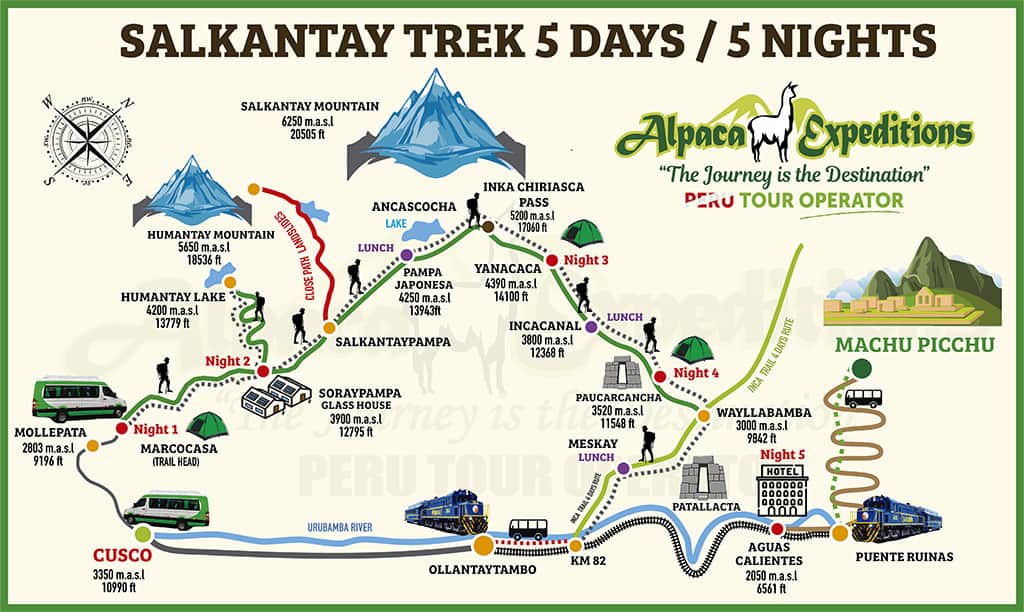
Salkantay is essentially Inca Trail’s lesser known cousin but beautiful in different ways. Taking a completely different pass, you’re treated to stunning landscapes of forests in the clouds, glaciers, and dramatic mountain terrain. You’ll also be taken through remote villages and less trafficked camp sites.
The difference in landscape to the Classic Inca Trail is just how much closer you are to the snowcapped mountains.
- Difficulty: Harder than Inca Trail (primarily because of the higher altitude)
- Distance: 60 km (37.28 mi)
- Altitude: 4,650 m (15,157 ft)
-
- This trail has lower demand but as a result, it will not be crowded and you’ll be able to literally show up to Cusco and sign up on the spot.
-
- With Salkantay you’ll get to even higher altitudes and there’s a chance you’ll even see snow. More off the beaten path.
-
- Since you start off from Aguas Calientes, you do have the opportunity to get into the city of Machu Picchu a lot earlier than the Inca Trail hikers if that’s what you decide to do.
-
- Only part of the path is a legitimate “Inca Trail” which is that well-groomed path you get with the Classic Inca Trail.
-
- There are Inca sites along the way but I would say less impressive.
-
- The biggest drawback is the fact that the hiking ends at Aguas Calientes where you then become part of the hoard of tourists that arrive by train.
-
- If you decide to do the Sun Gate you’re guaranteed to show up later than the Inca Trail trekkers.
Lares Trek
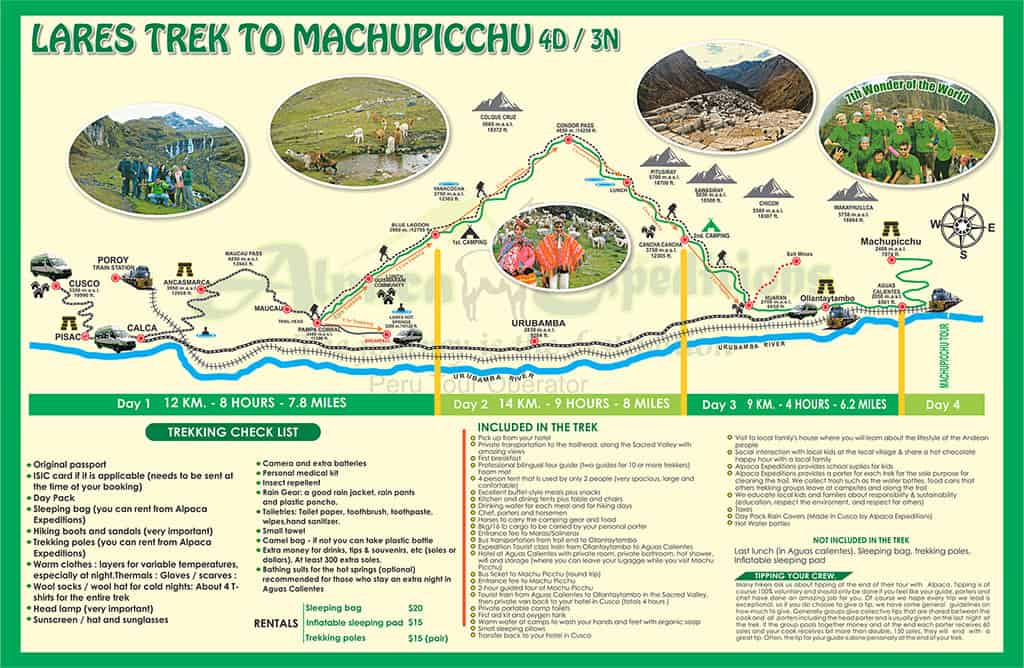
There seems to be a gazillion ways to do the Lares trek simply because there’s no fixed trail and it’s a mishmash of a few components – trekking, crossing some mountain pass, and visiting a local families.
The Lares trek may not be as well known as the first two but it does provide a very well-balanced experience.
- Difficulty: Moderate
- Distance: 42 km (26.10 mi) (varies)
- Highest Altitude: 4,500 m (14,760 ft) (varies)
-
- Passing through local Incan villages where you’ll get a glimpse into local life. You do not get this on the Classic Inca Trail or Salkantay Trek.
-
- This trek is much easier so there’s less worry of altitude sickness affecting you.
-
- Usually there’s a stop at the Lares Hot Springs which is a nice spot to relax.
-
- Does not go through any of the “official” Inca trail. The exception is the 5D4N Lares Trek which combines with the Inca Trail 2D1N with camping option.
-
- The trek will feel disjointed because you’ll hop on a van to the start of the trek, trek a bit, then spend some time in a few villages, and when you’re done, you’ll end up in Ollantaytambo where you’ll take a train to Aguas Calientes. Like Salkantay, you’re not really hiking right into Machu Picchu.
The Others Treks
There are many other options that vary in route, length, and difficulty but the above 3 are certainly the most popular.
If you’ve gone this far down the list, we might just consider taking the train up to Machu Picchu. Trust me, there’s nothing wrong with that considering everything we went through along the Inca Trail.
At the end of the day, you want to make sure you pick the trek that suits you the most in terms of what you want to see and how much of a challenge you’re willing to take on.
How To Pick A Trekking Operator
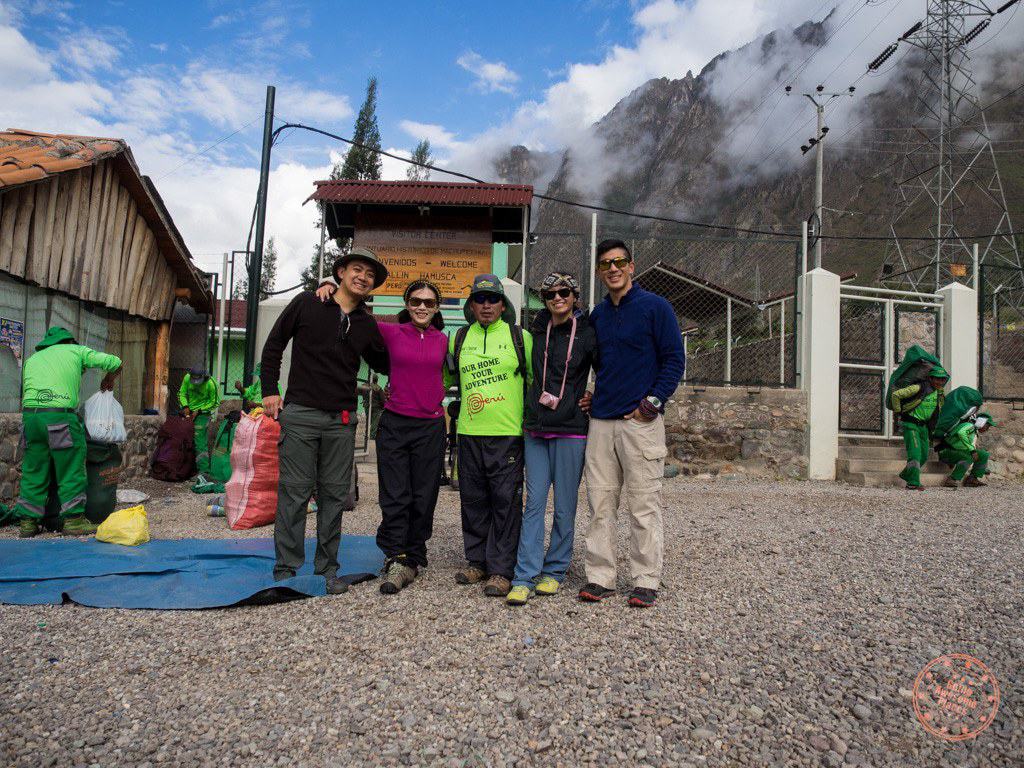 Preparing to start our Inca Trail hike
Out of everything this was the hardest because there was so much choice out there. When you take a look at TripAdvisor and Cusco’s top activities, and you’re presented with an overwhelming list.
What To Look For
For most, I think your three deciding factors are going to be 1) price, 2) experience reviews 3) options. These two are self-explanatory but the trick is to find a nice balance between the two.
- Price – As you start researching, you start noticing that the prices range quite wildly from low to high. Alpaca Expeditions for us was on the cheaper end of things and we couldn’t see any big differences from ours to the other companies we saw on the trail that charged significantly more.
- Reviews – We all know that reviews matter. At first we were skeptical of ones that had a crazy number of reviews but after reading through a few, they all looked legitimate and touted good experiences. The trouble was that we barely saw any negative reviews for any trekking operator.
- Options – We didn’t realize it initially but we definitely looked favourably at companies that had availability on a daily basis, offered a range of trek lengths and also provided a private option.
While we wish we could say definitively which operator is ‘the best’ but that’s pretty much impossible unless you get to try each one first-hand. The best we can do is reflect on our experiences with Alpaca Expeditions and why we were really happy with how everything turned out.
Why Alpaca Expeditions
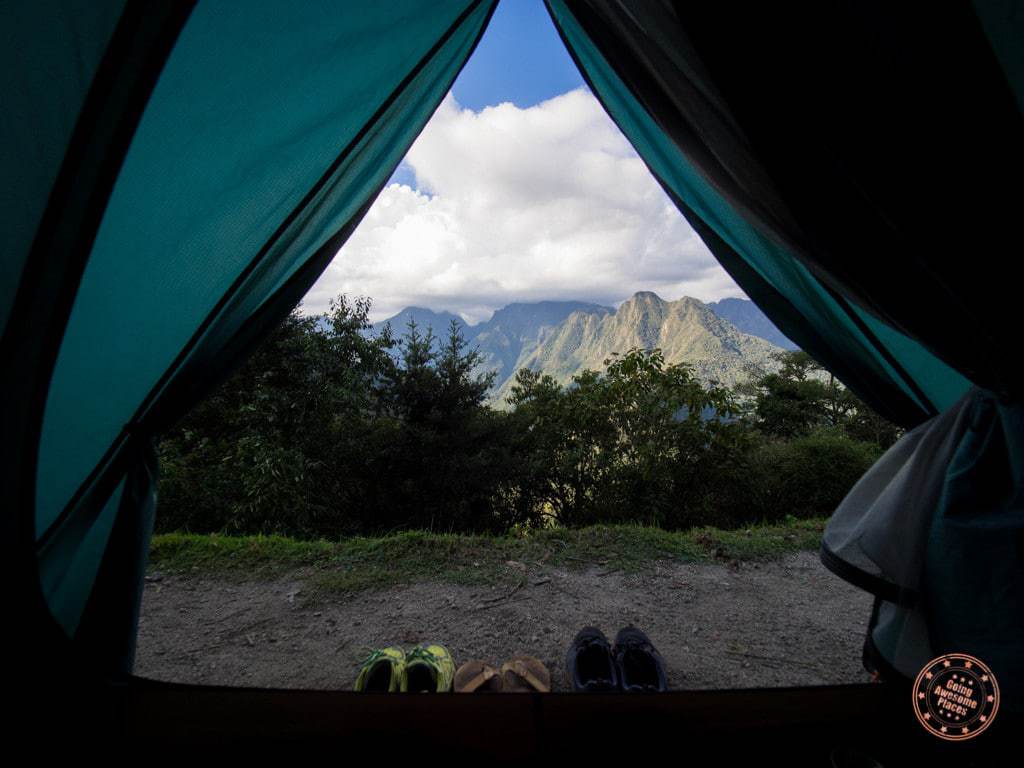
Our opinions here are obviously biased because Alpaca Expeditions is the only trekking that we’ve had personal experience with.
Overall we had a great professional experience with the company from start to finish and we’d highly recommend them. They have such a large number of reviews because so many people have good things to say about them.
The Booking Process
In order to book our trek, we did everything through e-mail. A deposit of $200 USD per person was required by Paypal and the remainder we paid when we arrived in Cusco. More on payments later.
The Porters
For the trek itself, there’s not enough that can be said for the team that was assembled for our private 4D/3N trek. We had a little over a 2:1 ratio of porter to hiker and they did a fabulous job everyday with the setting up of camp, cooking incredible meals, and running the Inca Trail.
They were the true super stars of the trail.
The Food
Every meal along our Inca Trail to Machu Picchu hike, we were blown away by the food they were able to cook for us given that everything they used had to be brought up along the way.
From delicious portions of chicken, beef, and fish to a nice balance of quinoa, beets, potatoes, and other mixed veggies, there was aways more than enough food to go around the table. Chef Yuri was masterful with his presentation as well, making sure that we were always surprised with his carvings.
If that wasn’t enough for food you can have in the mountains, we were also treated with flambé on our first night and even full sized cake to close things off.
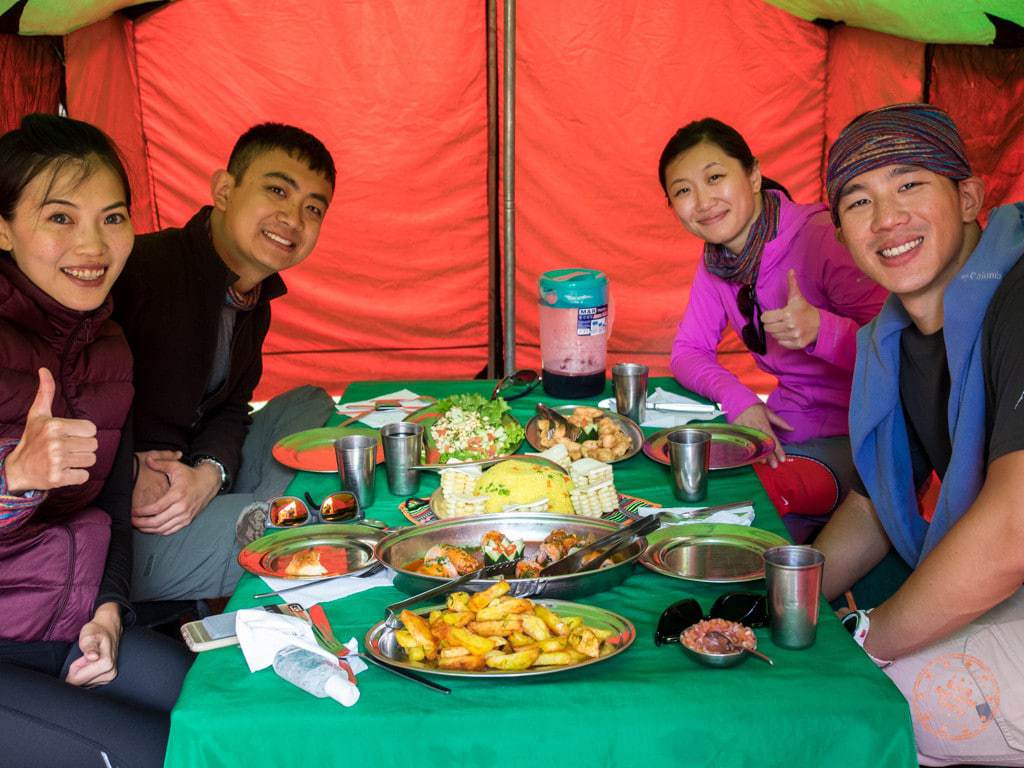
Beyond the breakfast, lunch, and dinner, every morning we’d also receive a little snack bag of goodies that would help us energize along the way. This meant that we didn’t even get a lot of chances to eat all of our Clif Bars.
Upon arrival at camp in the afternoon, there was also a ‘happy hour’ as they’d call it where you could eat an assortment of snacks like biscuits and popcorn to tide you over before dinner.
Our Trekking Guide
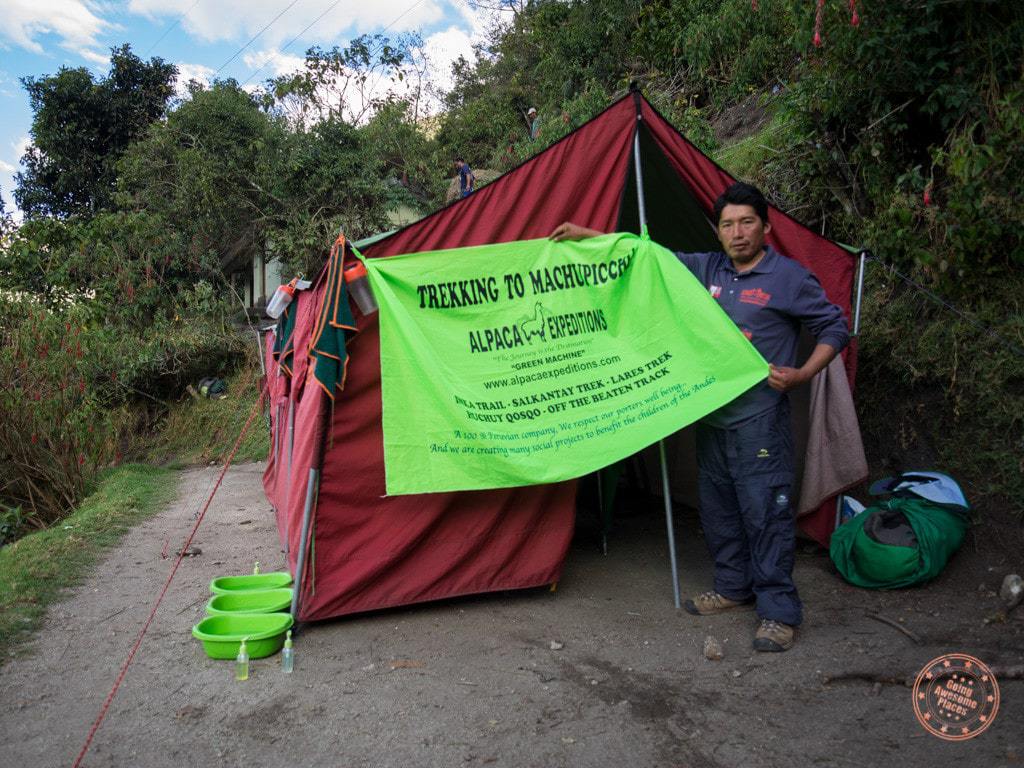
Our guide, Juan Carlos, was quirky and random at times but he was great to be around as he guided us through the trail. As a private tour, we had the ability to largely set our own pace and take breaks when we wanted.
He also helped set the pace when we needed to get our butts moving.
Along the way we encountered numerous Inca sites and he did a great job of explaining the history and story behind each one.
His experience really shone through in the few instances that we either needed medical help or one of us fell ill. When we needed medical help, he also had the necessary supplies to triage the situation.
In my case, I was feeling the effects of exhaustion on the first day and with one look he was able to determine if I was good enough to make it through. Another time, I was struggling with the sheer camera weight on my back and he offered to carry it for a stretch which helped a lot.
When Chantelle tripped on the final day of the trek, Juan Carlos had anti-inflammatory cream and compression wraps ready in his backpack. He even gave us a brand new tube of the cream before we left. Sufficed to say, he made sure to take care of us.
The Camp
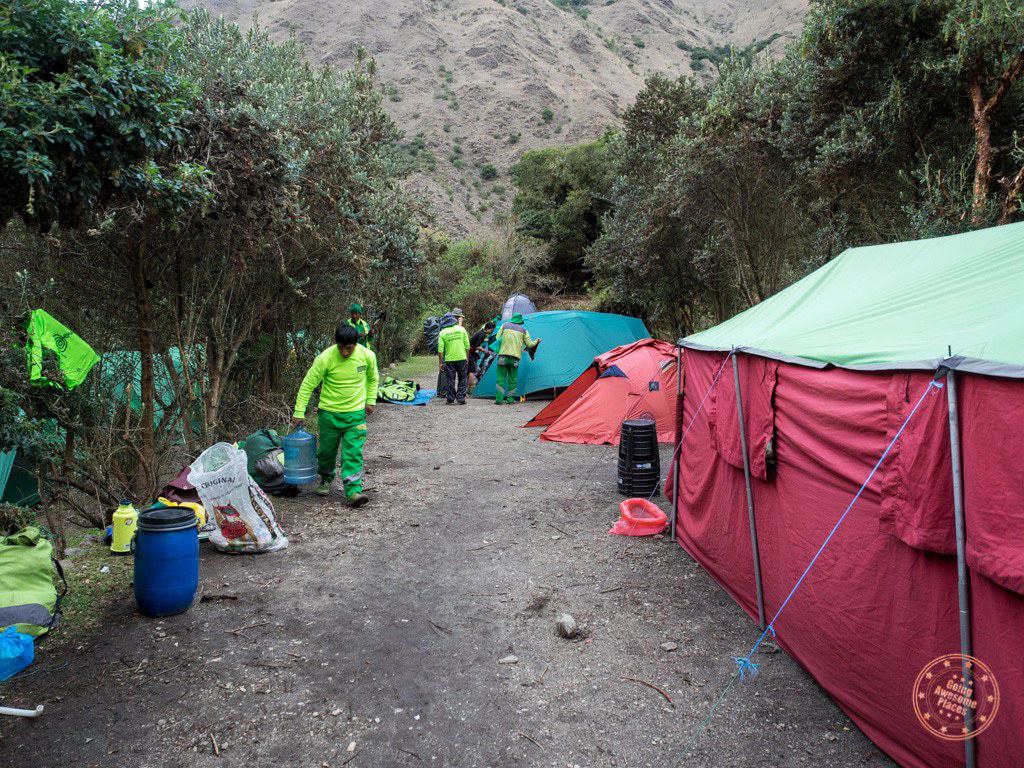
Every night we’d set up camp in a different area of the trail and typically we’d share the area with a few other trekking companies. This was never really an issue though because we always had our own contained space that didn’t mix with other groups.
Our set up looked like this: 2 tents for the 4 us + 1 tent for the guide + 1 main tent that tripled as a kitchen, dining area and also sleeping area for the porters + portable toilet.
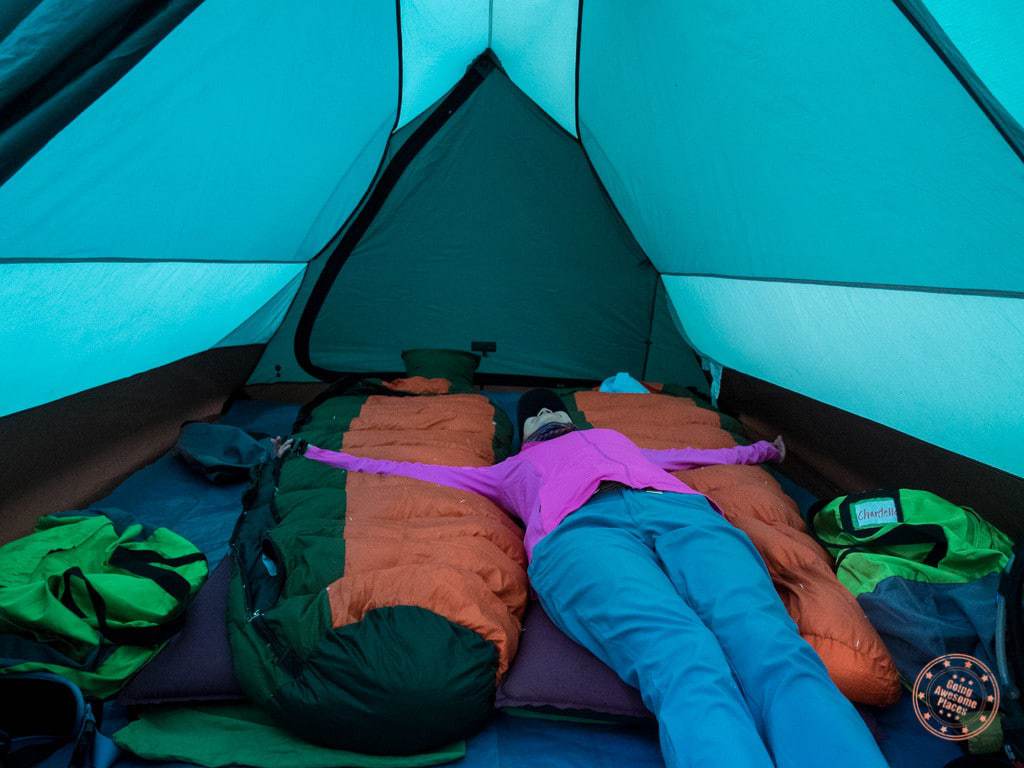
One of the biggest things that impressed me was the quality of the equipment and how comfortable our tent arrangement was.
Regarding the tents, they were very spacious for two people with enough space to put your daypack and duffle bag by your side plus room to spare. It was incredibly comfortable because there was the luxury of having two whole sleeping pads on your back, a plush pillow for your head, and clean sleeping bag liner.

Undoubtedly, one concern is going to be the toilets but that turned out to be a non-issue because our group essentially had our own tent set up overtop a portable toilet. The tent could be zipped opened and closed to keep the bugs out.
The toilet itself was comfortable to sit on and even had its own water pump flushing mechanism built in. The only learning curve was in not throwing the toilet paper into the toilet.
Hand sanitizer was provided to wash up.
The Alpaca Difference
From spending all of that time with our guide, we learned quite a lot about the company and why he loves his job so much.
From our conversations with him, we learned how the company was founded by a former guide and someone local to the Sacred Valley. As a result, the company was built around the philosophy of making sure they take care of the needs of their guides and porters.
For instance, they run extensive training programs for new hires including English-language education.
Understanding the need to increase knowledge and the importance of technology, the company also runs training programs on how to use smartphones and computers which we thought is a really great idea.
Lastly, we also found out that the company was planning on building housing in Cusco since most people live in the countryside and a significant cost to their employees is the need to pay for rent when they’re working.
All of this proved to us that they truly do care for their employees.
What to Pack for Machu Picchu Hike

Prior to leaving for Peru, we shared everything we packed for Peru. This is an exhaustive list of everything we brought for the entire trip.
To complement that article, we also want to provide additional insight from our first-hand experience that will be invaluable for how you’ll want to think about your Inca Trail packing list.
Alpaca Expeditions Promotion
When had a fabulous experience trekking with Alpaca Expeditions. We’ve partnered with them to offer a special promotion for free hiking sticks and sleeping pads. The full details on how that works is at the bottom of the article.
The Green Duffle
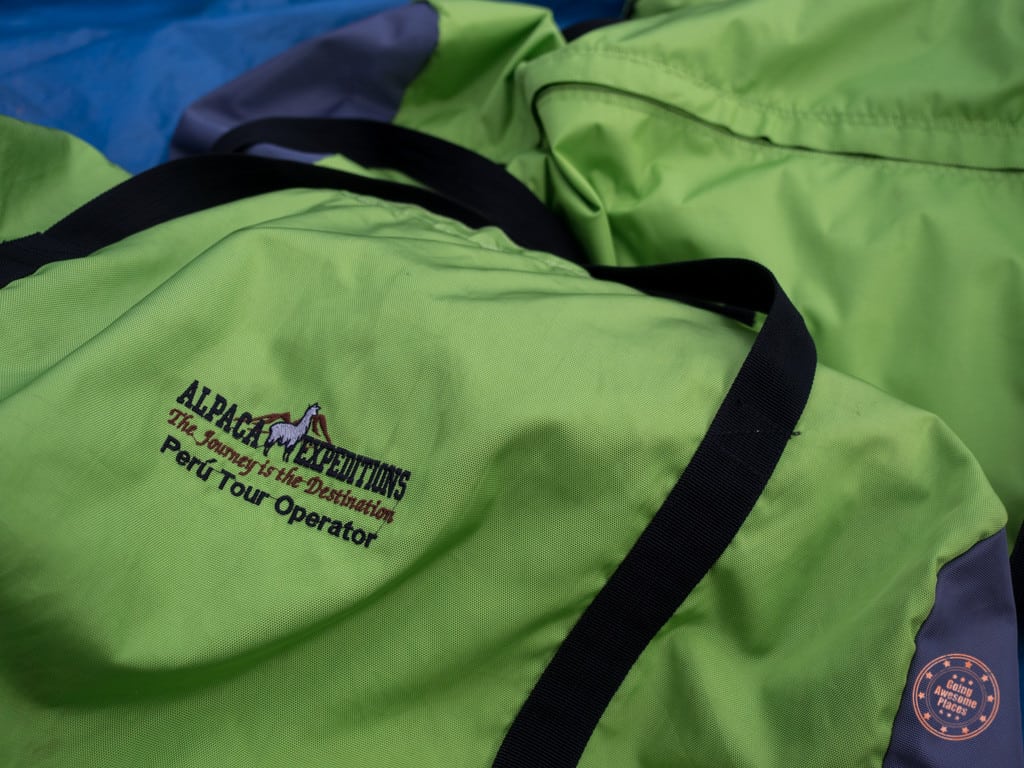 Alpaca Expeditions’ duffle bags
What took us by surprise was just how little you can bring on the trail. You’re allowed to bring a lot less than you think.
Prior to the trek, each person is given a duffle bag where you’re supposed to throw in everything you need beyond your day pack gear. This means things that you need but don’t want to carry all day (i.e. clothes and toiletries).
The detail that is easy to miss is the fact that each duffle bag can only weigh a maximum of 7 kg because the government strictly enforces how much weight each porter is allowed to carry. The kicker here is that they don’t tell you that this includes the pillow, daypack rain covers and poncho that Alpaca Expeditions provides. With those items included in the mix, that means you actually only have 4 kg of things you can bring.
As a result, we ended up spending a lot of time the night before repacking, weighing, and cutting more and more things out.
Packing In Hindsight
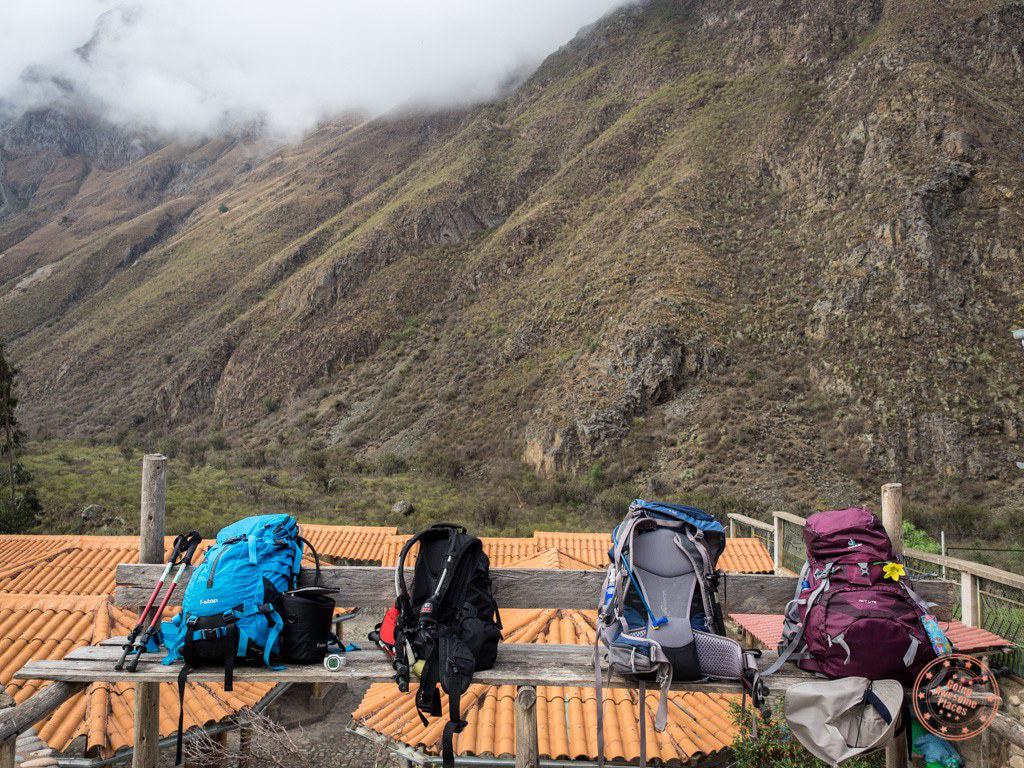
You always try to pack with all sorts of situations in mind and based on prior experience but as you know, travel is unpredictable and there are a ton of things that we would do different knowing what we know now.
Bring less of:
- Camera gear – This one was a hard one for me but for the hike itself, I definitely shouldn’t have brought the 40-150mm telephoto lens which wasn’t used at all.
- Tripod – We got a few star trail shots but were they worth it? Not really. The tripod weight made it really tight to fit what I wanted to in my duffle.
- Gym gloves – Initially packed for additional grip but realized they weren’t necessary and also didn’t provide any warmth. These merino wool gloves would’ve been more helpful on the cold mornings.
- Wipes – We read that it would be a good idea to bring a lot of wet wipes to clean up but Alpaca Expeditions was so well equipped that we didn’t end up needing them. Every morning and night we were given a piping hot bucket of water, soap, and a towel.
Bring more of:
- Travel-friendly toilet paper – When you have stomach issues, having your own toilet paper is handy. There’s plenty at camp but when you need to use it on the trail, it’s best to have your own.
- Hand sanitizer – Always useful to have your own.
- Insect repellent – If mosquitos love you, you’re going to want to bring more than you think.
What I’m glad I brought:
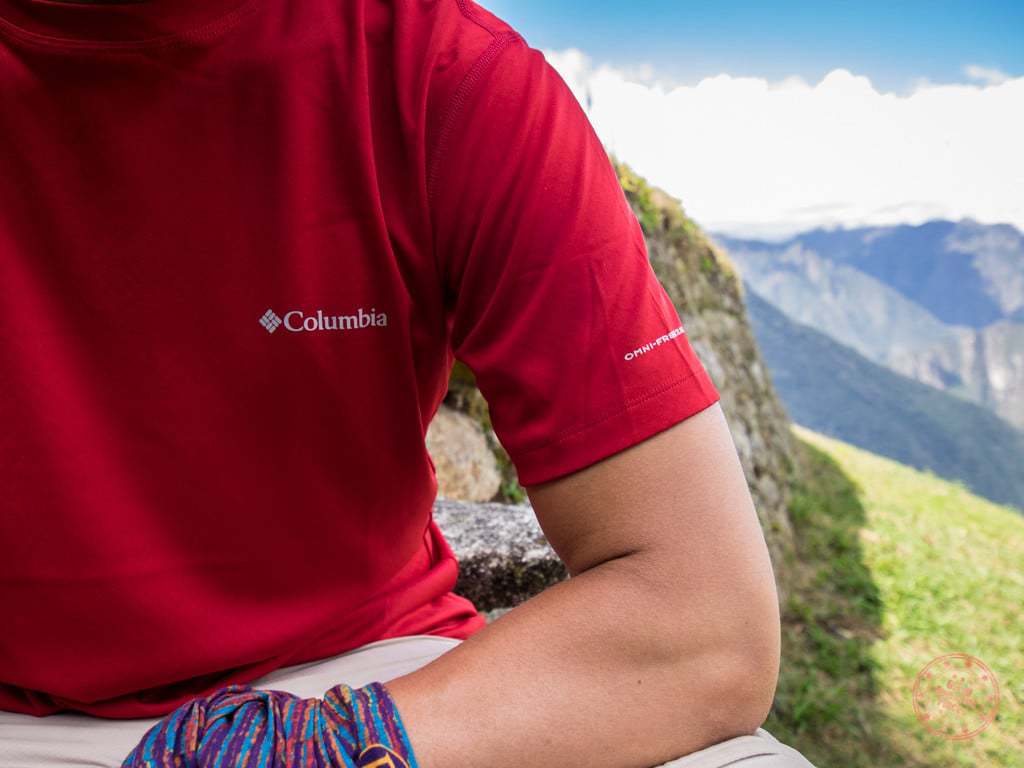
- Altra Lone Peak Shoes – Originally, we hiked with Columbia Outdry shoes which were incredibly comfortable, waterproof, and performance oriented. If were to select a shoe today, it’d be the Altra Lone Peak shoes which is what I used for my Patagonia itinerary.
- Dry-fit clothes – Avoid cotton. Instead, breathable and moisture-wicking clothes are highly recommended.
- Lightweight poncho – The poncho they provide is heavy duty and way too bulky to carry in a daypack so having a simpler disposable poncho is a better idea.
- Medicine – Advil, Pepto, Tylenol Cold & Sinus, and Emergen-C came in handy.
- Hand sanitizer– Goes hand-in-hand with the toilet paper.
- Easy access to your camera – The Peak Design Capture attached to any backpack makes it easier to take photos as you hike. Today, I’d pair an adventure-oriented OM System camera with the Shimoda Action X50 for a trek like this.
- Hydration bladder – Water bottles are a bad idea on this hike because you want to have access to water as you hike. Bladders make it incredibly convenient to get that constant sip of water to keep hydrated.
- Buff – This was clutch as always. I could put it over my head and ears when it got cold or around my wrist at other times.
- Clif Bars and other snacks – While Alpaca Expeditions provided snacks for the day and the meals were packed, it was still nice to have these on hand for a nice energy boost.
- Hiking socks – Having good socks was key to make sure I didn’t have any problems with my shoes. They also kept me warm at night. Highly recommend merino wool ones.
- Headlamp – You’ll want your own in situations where you’re hiking in the dark or around camp at night.
Things we wish we packed:
- Second pair of long pants – We recommend packing a two high-quality pair of technical pants. They’re definitely worth the investment.
- Long johns – We only mention this because Day 2’s campsite was frightfully cold at night. We didn’t feel warm all night, definitely needed more layers.
- OEM camera batteries – This was a great lesson learned. we’ve never had issues with third-party batteries but starting in Cusco, we started noticing that my batteries were abnormally expanded due to altitude. Since then, we’ve only purchased original batteries.
Daypack Considerations
If there’s anything to take away from this is the fact that you want to pack as light as possible. Weight is directly proportional to hiking misery. We won’t tell you what to put in your daypack but here are things you’ll want to think about.
- Water is a must but it’s a double edged sword because it’s a significant part of the daypack weight. As a general rule of thumb, you’ll want 1-2 liters with you for each half-day. Keep in mind that you’ll be able to refill on water at lunch.
- Don’t bring a backpack cover because Alpaca Expeditions actually provides one. This helps keep your daypack clean because you’ll be dropping it on the ground all the time.
- Layering is key. This was handy having that fleece for when it got cold.
- Don’t bring your own hiking sticks. I thought about buying a pair but ultimately it didn’t make sense to lug that weight around for the whole trip. They’re cheap to rent. The same goes for sleeping bags and pads.
Inca Trail To Machu Picchu Hike Itinerary Guide
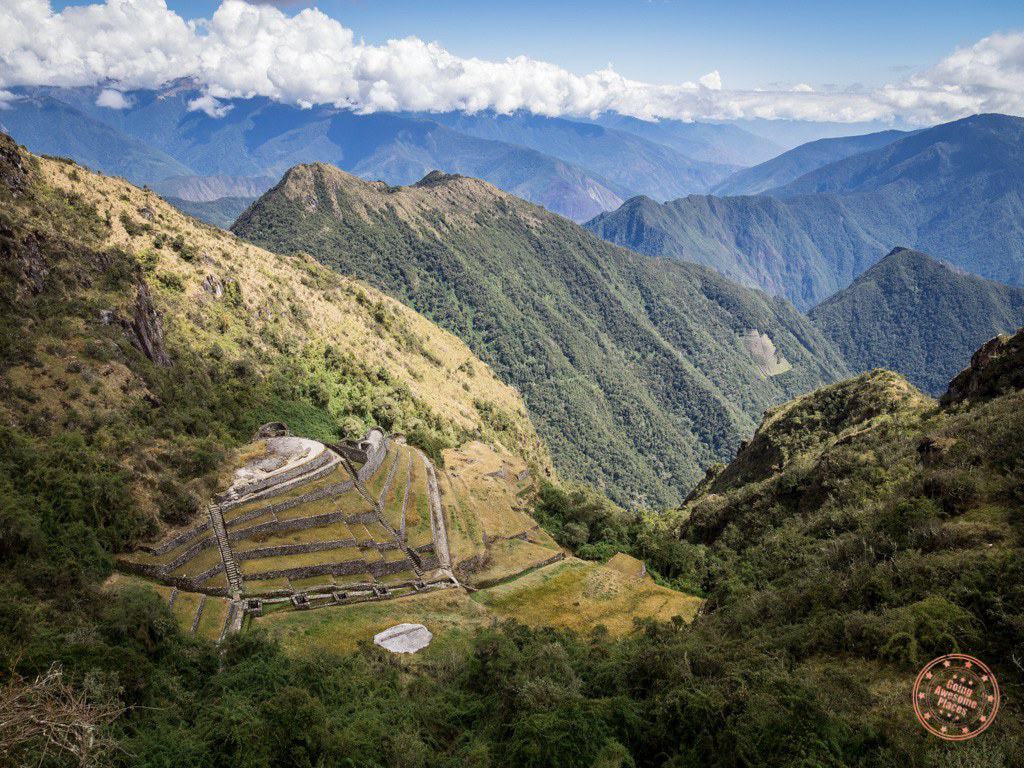
The trail itinerary is pretty standard in that all companies take the same route. The only difference I could discern was that each company had it’s own camp sites whether for lunch or the evening. With that said, there are a few micro details that are easy to miss when planning out your itinerary.
- Bag Drop Off – You’re going to travel to Peru with way more than you’re going to want to bring on the trail. Have a plan for where you’ll be leaving your bags. Luckily, most hotels and hostels will be used to this so they should have luggage storage. I would double check to make sure.
- Acclimatization – Unless you’re a glutton for punishment, make sure you schedule in 2-4 days in Cusco where you can do what we did which was explore the city and do the tour around Sacred Valley. This will be a huge part in adapting to the change in altitude.
- Remaining Balance + Briefing – We planned a pretty tight itinerary and we only realized after the fact that we didn’t account for time to go to the Alpaca Expeditions office to pay the remainder of what we owed. The other thing we didn’t account for was the hike briefing. This is done with your assigned guide. Our schedule was so packed that the only time we had for this was at 8PM on the day before the hike. Luckily, Juan Carlos was able to accommodate and arranged to meet us at our hotel.
Best Time Of The Year To Go
So far we’ve talked about which trek to do, which operator to go with, and what to pack but what about when to go? Ultimately there are a few factors to think about when planning a trip to Machu Picchu.
- Wet vs. dry season
- High vs. low season for tourists
Here’s our breakdown of when you should come:
- January – March: This is rainy season. February is so bad that the Inca Trail is fully shut down.
- April: Nice pleasant weather as the temperatures are warmer side but not extremely hot. Low season for tourists.
- May – June: The weather continues to cool down through the transition into winter and can be considered fresh (remember that Peru is in the Southern Hemisphere). Tourism starts to pick up again but is still manageable
- July – August: This is the height of tourism which means that the trail will be packed and so will Machu Picchu. High season of course corresponds to the summer holidays in most parts of the world. Ironically, this is also the most comfortable time of the year to go because nights are cool, climates are pleasant, and there is very little chance of rain.
- September – October: These two months are great shoulder months. Tourists starts to taper off a bit and the great weather continues to hold.
- November – December: These months are decent but you’re taking a risk on weather with higher chances of rain and temperatures continuing to climb as it moves into the height of Peru’s summer.
Best Time To Do The Inca Trail?
We recommend May, June, September and October. These provide a good balance of dry weather, balanced climates and drop-off in tourist crowds.
Dealing With Altitude

No matter how you slice it, high altitude sucks for us sea level dwellers. While it’s really hard to say how your body is going to react, we will speak from personal experience how it was for us.
Completely counterintuitive is the fact that Cusco’s altitude of 3,339 m (11,150 ft) is higher than Machu Picchu itself which is 2,430 m (7,972 ft). This matters when you plan out your Diamox prescription.
You don’t actually hit high altitude when you start your trail. It starts when you land in Cusco so make sure you count out your days properly because most doctors won’t know.

Coca tea is the local remedy to altitude and we drank it the whole time. It was the kind of thing that didn’t taste bad and so we figured there was no harm. Some people hate it but to be honest, it tasted like green tea.
We already mentioned it above but acclimatization is important. When you plan out your trip, make sure you account for at least 2-3 days in Cusco where you don’t do anything too physically demanding.
While this didn’t exactly help with the challenges that were ahead of us on the Inca Trail, it made sure that our time in Cusco was a good one. The only effects we had was a bit of tingling in our fingers.
On the trail itself, there’s a mix of a bunch of things that can make you feel sick. I had tingly fingers and face for parts of it and it seemed to take longer to digest meals but where you’ll feel it most is just the lack of oxygen. With limited oxygen and never-ending stair climbing, our lungs were on overdrive. It actually felt like they were overworked and overstretched.
The biggest adjustments we had to make were:
- Learn not to push yourself too hard – Pace yourself because going too hard will drain away your energy so fast that you’ll fall into serious exhaustion which is something that happened to me.
- Remind yourself to breathe properly – Breathing is important because you need all the oxygen you can get up there.
Money
This certainly isn’t the top of your list of things to plan for but we found ourselves wondering about two things as we were wrapping up our time in Cusco and preparing for the Inca Trail.
Spending Money
We were told prior to going on the trek that we should bring at least $100 USD worth of Peruvian Nuevo Soles (PEN) in case we wanted to buy something along the way. Turns out you don’t need that much but you’ll want to make sure you have some in your pockets for the few spots where you’ll need it.
On the first day you eat breakfast at a restaurant called Sexy Llama in Ollantaytambo and here, you’ll have one last chance to buy last minute gear.
From a money perspective, what we will say is that you should make sure you break up your bills for dollar PEN coins.
We say this because during the first half of day #1’s trail, you’ll be passing by many local farms and if you have to use the bathroom, they charge 1 PEN to use their toilet. And yes, they do provide toilet paper.
Other opportunities to use money include a few stands that locals have set up along the trail. You’ll encounter most of them on your first day and at the way-station right before Dead Woman’s Pass ascent. Beyond that, there aren’t any locals as we were led to believe.
 The market outside of the train station in Aguas Calientes.
The remainder of the money you want to prepare is for the toilet at Machu Picchu, lunch in Aguas Calientes, souvenirs you may pick up at the market set up right outside the train station, and of course tips.
Tipping
This is always a sensitive subject and of course you want to make sure you tip according to the quality of the service you receive. That being said, you kind of need a guideline to work off of because we sure as hell didn’t know what was reasonable or not.
Alpaca Expeditions recommends the following:
- 60 PEN per porter
- 150 PEN for the cook
- Your own discretion for the guide
Our breakdown per person ended up looking like this:
- 190 PEN for the porters and cook
- 70 PEN for the guide
Our recommendation is to figure out your tips before your last dinner at the end of Day 3. Otherwise, you’ll end up awkwardly scrambling at the table.
We ended up accounting for 2.5 porters per person. The calculation looked like this:
- 60 PEN for the porters x 2.5 porters / 4 people + 150 PEN for the cook.
Another piece of advice is to not bundle the cash together for the porters and cook. We realized after-the-fact that this left it up to them to figure out the split between the cook and porters. Keep it clear and pay the cook separately from the porters.
The guide is paid last. At first, we thought this was going to happen at dinner but it actually happened at lunch in Aguas Calientes when we said our final goodbyes.
Withdrawing Money
Before coming to Peru, we exchanged a small amount of PEN at our local Canadian bank but there was no way we were going to convert enough for the whole trip. So as with any other trip, we planned on withdrawing money along the way.
ATMs
Using our debit card we was able to successfully withdraw from several ATMs. We found that Scotiabank in Cusco worked well. Make sure to avoid ATMs that charge their own fee.
Local Money Changers
Another way to get more local currency is to convert USD to PEN. Banks aren’t going to give you competitive rates so what I did was walk around the city to find out what the local money changers were quoting. All of them seemed to have the same rate so we eventually settled on one near the main square. Make sure to double count all the money in front of them.
Spend USD Directly
Many guides and forums recommend taking USD and using it to pay for things in Peru. However, in speaking with to locals, they discouraged us from doing so. Why?
When you spend USD, locals will use an arbitrary exchange rate that is much worse than the market rate. That, or they’ll quote you a USD amount that is significantly more expensive compared to the PEN amount.
Cash Strategy
The best strategy with Peruvian currency was to have some in-hand before arriving in Peru and convert along the way as-needed. You’ll have to judge how much you need for certain legs of the trip because you also want to make sure you don’t over withdraw/exchange either.
Here’s how much our trip cost back in 2015. Granted, prices have increased but this should give you a good ball-park.
- 4D/3N Classic Inca Trail with Alpaca Expeditions – Private Tour = $1,660
- Huayna Picchu = $75
- Sleeping Bag = $25
- Hiking Poles = $20
- Tips = $80
Total Cost = $1,860 USD per person
Mosquitos
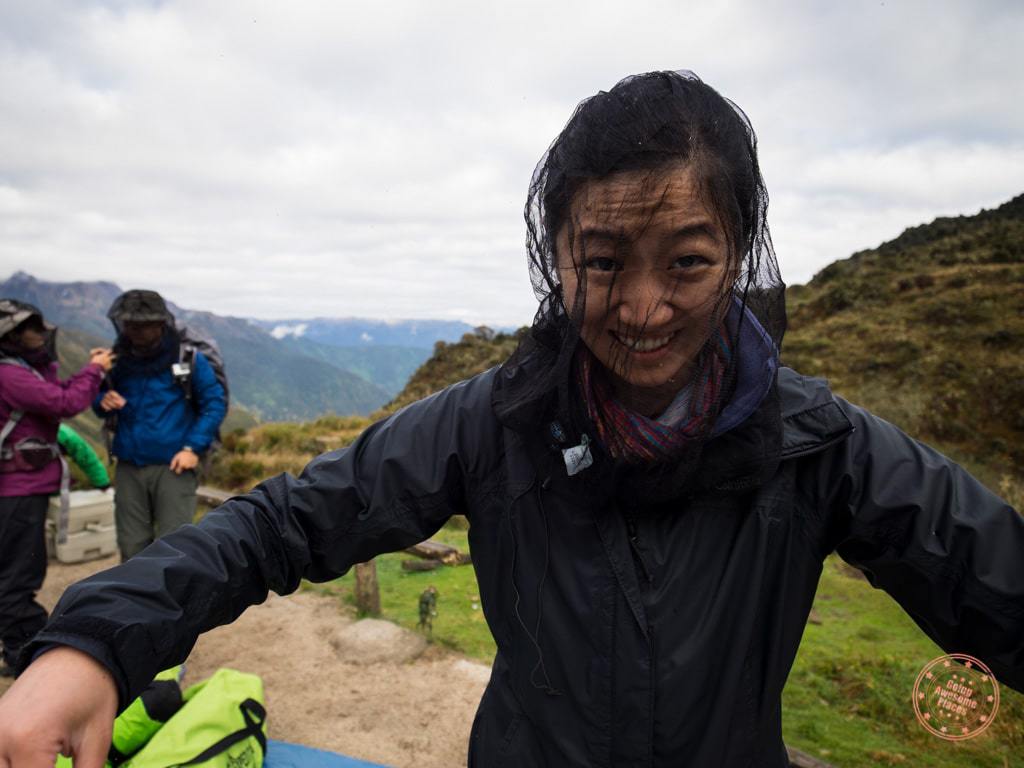
You’d think that dry, cold and high altitude climates would dissuade blood-sucking creatures from thriving but let me tell you, they’re vicious up there. Among everything we encountered, this was the biggest surprise. We knew the Amazon Rainforest would be bad but the Inca Trail as well?
What makes these mosquitos so brutal is the fact that they’re really tiny and pack a wallop when they bite. They’re small which means you think they’re just regular flies at first. When you realize they’re mosquitos, it’s already too late.
The mosquito bites were particularly memorable because :
- They leave a drop of blood after biting
- The bites swell into hardened welt and seem to stay for a long time. I noticed with mine, bite scars seemed to last 2 months and would randomly itch.
The only solution we had for this was deet insect repellent. Spraying it on exposed skin was the only countermeasure that seemed to keep them away.
I’m not convinced that you need this for the Inca Trail but to our surprise, we actually had to use our mosquito head nets on the morning of Day 3. After breakfast, we came out to pack up our gear and we were literally swarmed by hundreds. It was so bad that even the porters were asking for our insect repellent.
To Huayna Picchu or Not?
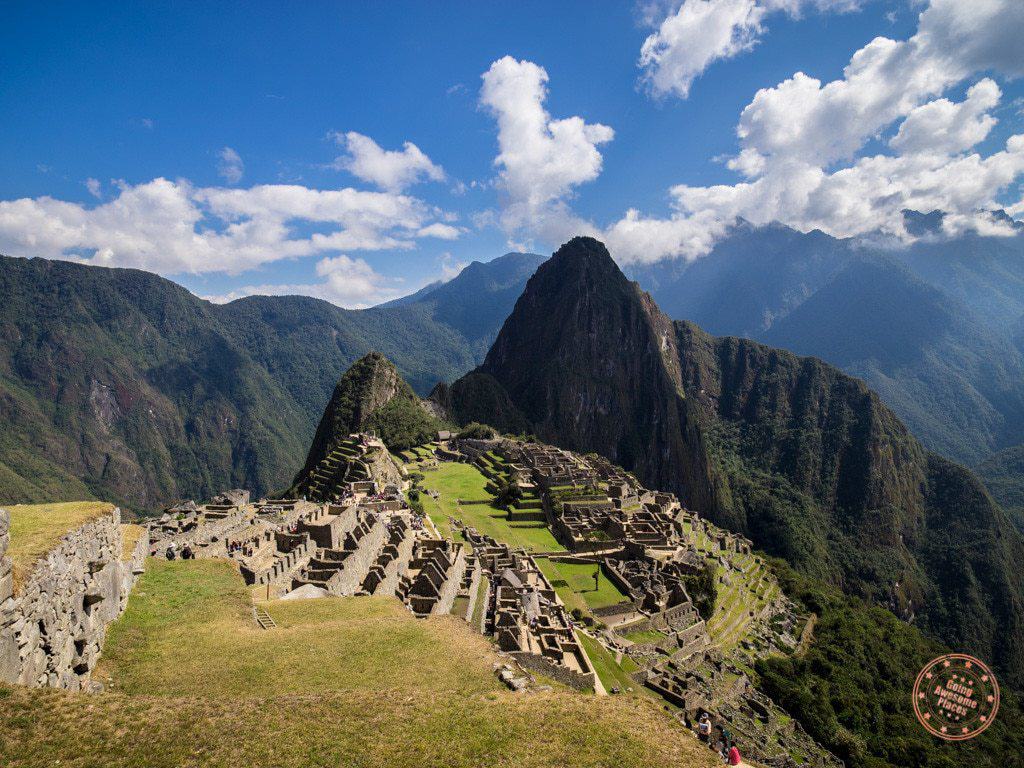
After 4 days of strenuous hiking and bouts with altitude, we remember coming down from Machu Picchu and asking Juan Carlos which one was Huayna Picchu.
Let’s just say it’s not that little hump on the left.
When we realized it was the towering mountain to the right, doubt started creeping in. It’s hard to see in this photo but from afar you could see the outline of the sheer vertical climb that outlines the spine of Huayna Picchu. It looked crazy.
Since we booked the permits for Huayna Picchu beforehand, we had a call to make. To climb or not to climb?
In the end, 3 of us decided to do it and after our quick tour of the city’s ruins, we raced to the back where the entrance to the mountain is.
We almost didn’t get in. At the front gates was a big sign that said that there are two time slots for entry each day: 7-8AM and 10-11AM.
I looked down at my watch and it was 11:10AM. Luckily, Juan Carlos worked his magic and got the attendant to let us through. With only 2 hours to work with, our guide instructed us to turn back down after an hour no matter where we were on the mountain.
We somehow found another gear and ran to the top of Huayna Picchu and back down in less than 2 hours. Part of it had to do with the fact that there was way more oxygen at this altitude and the other was that we knew we would miss our bus down if we were too slow.

Was it worth it? Absolutely. We would recommend this add-on hike for anyone that wants to see Machu Picchu from a different perspective. The trade-off is that you take away from time to explore the ruins.
You also need a massive burst of energy to do this segment so make sure you think about whether your knees will be up for more punishment.
The only regret we have is that we didn’t have more time to explore the side trail of the mountain that takes you to the Temple of the Moon.
We’ve written a full guide on whether Huayna Picchu is worth it or not. Make sure you check it out!
Do You Need Travel Insurance?
This is a common question that anyone planning a Inca Trail trek is going to have.
“Do I need travel insurance?” and “Is travel insurance really that necessary?”
The answer is yes to both.
While you may feel invincible, we think the main thing I’ve been trying to hammer home with my Inca Trail truths and everything we learned about hiking to Machu Piccu is that you just don’t know how hard you’ll be hit with altitude and moreover, you just don’t know when something bad will happen.
Luckily, our group was able to pull through despite the severe diarrhea, twisted ankle, and massive exhaustion but if it was any more serious, we’re talking about hospitalization, emergency evacuations, or worse.
That’s why we never travel without travel insurance. How to buy the right travel insurance is hard but once you figure out what you need, you’ll have the peace of mind that you’ve got a plan if shit goes wrong.
For the Inca Trail specifically, you’ll want to make sure you’re going with something like HeyMondo that already includes adventure sports coverage. If you read their coverage, their basic policy only includes trekking up to 3,000 meters but they have an adventure sports add-on that brings this up to 5,000 meters.
Everything Else You Should Know About The Inca Trail
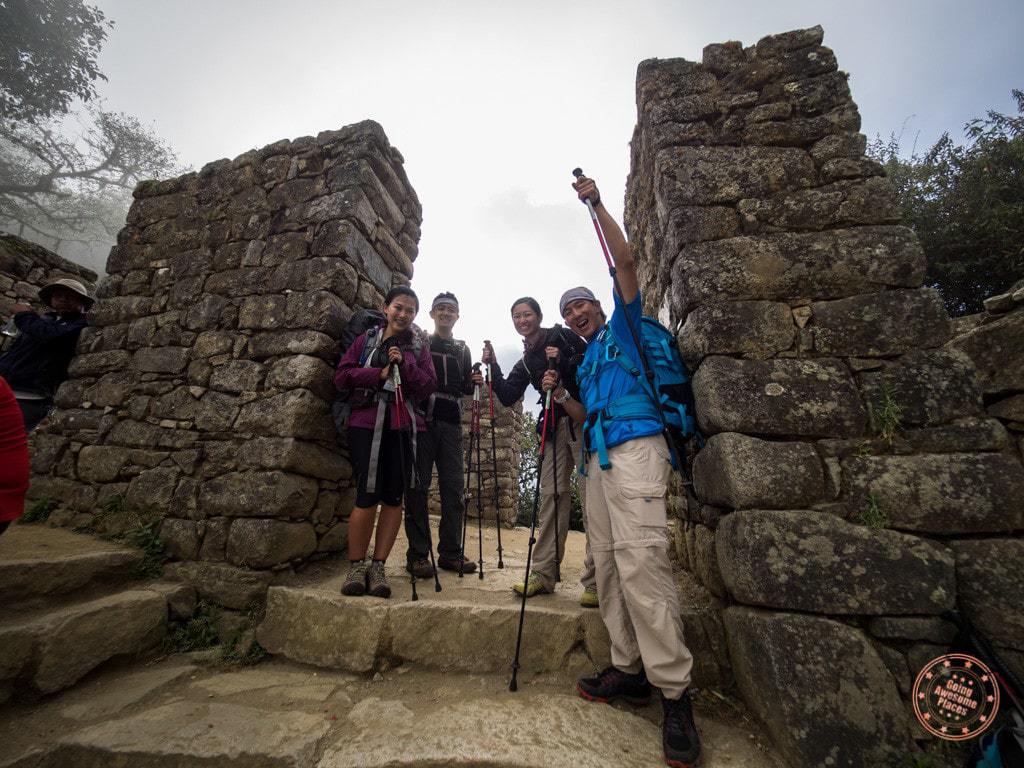
We’ve just about covered everything but there are a few final things that I wanted to throw in here to help you adequately prepare for the Inca Trail.
- It’s dry as heck here – We mentioned it in our Inca trail experience wrap up but Cusco and the whole Inca Trail was ridiculously dry during the time of year we were there (September). My nose was chapped all the way through. Make sure you bring a chapstick.
- Bonus shower – We don’t know if this is a service that all trekking operators have but you don’t know how good it felt to have a warm shower on Day 3. They call it an “Inca Shower” for a reason. It’s literally a shower where you scoop hot water from a bucket into a bowl and pour it over your head manually. Trust us when we say that you’ll feel like it’s the best shower you’ve ever had.
- Zip locks – These were very handy to have. Additional storage and organization is obvious but they were good to have to store all of your toilet paper you use when nature calls on the trail. I’ll leave it at that.
- Cell service – You’ll only have signal the first few hours of Day 1, spotty data at Machu Picchu, and full service in Aguas Calientes and beyond.
- Cheating a little – As the days went by, we kept thinking of ways to shed weight from our day packs into the duffle bag. We were definitely over the 7 kg limit but turns out there’s a bit of wiggle room.
- Back out and in – There’s a rule that Inca Trail hikers can’t walk around Machu Picchu with your gear. As we came down we were allowed to take photos from the iconic platform but after that, you are forced to leave the park and re-enter, joining everyone else. No hiking sticks or large bags are allowed so you’ll have to store it there. If you’re with a guide, you can hand this over to them.
- One bathroom at Machu Picchu – From what I could gather, there’s only one bathroom facility and it’s outside the main entrance and it costs 1 PEN.
Top 10 Tips For Hiking The Inca Trail
I’ve covered all the core things but here’s the TLDR/essentials of what you need to know when planning a trip to hike the Inca Trail.
- Make sure to acclimatize – Arrive to Peru early and more specifically Cusco so that you have at least 2 days to get your body adjusted to the altitude. Remember, Cusco is actually at a higher altitude than Machu Picchu.
- Pack good sunscreen and bug spray – The bugs aren’t that bad but when they come, they hit hard. For those in the US, you can treat your clothes with permethrin or use bug spray with deet. For sunscreen we recommend Sun Bum 50SPF.
- Have altitude meds on hand – If you’ve never hiked at altitude, you want to make sure you’re ultra prepared with Diamox which you might need a prescription for. You can also try chewing coca leaves, the local remedy.
- Pack your own med kit – Your trekking guide will have some of the basics in their first aid kit but don’t chance it and bring your own first aid kit with add your collection of bandages, blister kit, something for upset stomach (Pepto-Bismol), antibiotics (Cipro), Emergen-C, sore throat lozenges, and something for headaches (Tylenol/Advil). You’ll thank me for being over-prepared.
- Pack light – Everything you carry on your back will feel like a bag of bricks at altitude. Bring as little as you can in your own backpack and put everything else in the duffle for the porters. Leave all non-essentials in Cusco.
- Use hiking sticks – Take advantage of our exclusive offer with Alpaca Expeditions and use those free hiking sticks included. They’ll help you on your trek especially when going downhill.
- Get a hydration pack – We are big fans of hydration systems such as ones by Hydrapak. As our guide recommended, keeping your lips moist is key and drinking often. You can only do that with a hydration pack.
- Powerbank to charge – There are no outlets along the way so make sure you bring a high capacity powerbank to charge your smartphone and camera batteries. Buy a camera battery charger that can charge via USB-C.
- Break in your shoes – You might be buying new hiking shoes for this trip but the worst thing you can do is wear it for the first time on the trip. Make sure your shoes are comfortable and don’t chafe in weird ways or cause blisters.
- Have cash ready – Pre-calculate your tips so you know what you need for your group and set it aside. You’ll also need local currency for the bathroom at Machu Picchu.
Where to Stay in Cusco Before And After
If you’re starting to plan your Inca Trail to Machu Picchu hike, you’re going to need to find a place to stay before and after the hike which means, figuring out your time in Cusco.
Below are a few of the recommended places that we personally stayed in (yes all 3) during our trip so we can vouch for all of them when looking for a place to stay in Cusco.
BEST

Palacio del Inka
Thanks to SPG points, we were able to stay here the night before our trek. We met Juan Carlos in the lobby for our pre-hike meeting and were treated with upscale rooms as you’d expect as this is part of SPG’s luxury collection.
MID-RANGE

Apu Huascaran Hostal
We stayed here after we returned from the Inca Trail and we were so glad to have this place because we really needed a place to rest with all of us recovering from some sort of ailment. This loft-style hotel was perfect for us as two couple with each of us with our own floor.
Recommended Activities In Cusco
You’re going to be spending quite a bit of time in Cusco so while you’re acclimatizing, here are a few top activities that I recommend that you book before they sell out.
If you’re looking to book with Alpaca Expeditions, mention that you were referred by “Going Awesome Places” and you’ll be able to get free walking sticks and sleeping pads. Also make sure to email us as well so we can resolve any issues that you may have.
How? When you fill out their booking form, their second step has a drop down for ‘How did you hear about Alpaca Expeditions’. Select ‘Going Awesome Places Blog’ in the drop down.

This is the best Alpaca Expeditions discount you’ll find on the market.
Frequently Asked Questions
Which is the best hiking trail to see Machu Picchu?
With all things considered, you really can’t beat the Inca Trail itself because it is the only one where you arrive at Machu Picchu early in the morning through the Sun Gate. There are also a large number of ruins and sights to see along the way that the other treks don’t offer.
What is the recommended number of days to hike the Inca Trail?
The 4 day 3 night option is the de-facto standard and what I’d recommend for most people that are coming to Peru to hike the Inca Trail.
Which is the best Inca Trail trekking company?
There are a wide range of trekking companies that do the Inca Trail route but one of the best is definitely Alpaca Expeditions.
Does Alpaca Expeditions have a promo code?
Yes, Going Awesome Places offers free walking sticks and sleeping pads as long as you say that you heard about Alpaca Expeditions from “Going Awesome Places Blog”.
How much does it cost to do the Inca Trail?
It costs $895 USD to do the standard 4D3N Inca Trail including Huayna Picchu, equipment rental, and tips. The private tour will cost $1,455 USD per person.
If you have any questions about your own Machu Picchu trekking trip and have questions about picking an Inca Trail operator or are wondering about some specific details about Alpaca Expeditions, don’t hesitate to drop a comment below!
Travel Resources For Your Next Trip
If you’re in the process of planning your trip and putting together your itinerary, these are genuinely the best resources that the Going Awesome Places team stands by 100%.
Credit Cards
Don’t get burned by hidden fees on top of terrible exchange rates. When we travel now, we use the Wise Card. Simply load it with the currency you need before you go and use it as a regular VISA or their digital wallet card. Use their free app to track how much you have and top up when you need to.
Flights
In our opinion, of all the booking search engines, Skyscanner is the most helpful and easy to use thanks to their Everywhere feature. Kayak is also another that’s we will often check.
Rideshare
You probably already have accounts but if you don’t, for new Lyft users, use code WILLIAM4825 to get 50% off your first 2 rides (max $10 USD per ride). Offer valid for 14 days after you take your first ride. For new Uber users, use code psuqbjg4d7rn for the same offer except it’s valid for 30 days.
eSIM
eSIM: Lately, we’ve really loved using eSIMs. We’ve tested several over the years and we have access to a few special promotions.
- AmigoSIM – Use GOINGAWESOMEPLACES to save 25% off. Code is re-useable.
- Gigsky – Use TANG149 to get $3 USD when you sign up, then use code GOINGAWESOME to save 20% on all eSIM orders.
- Airalo – Use referral code WILLIA9500 to get $3 USD credit on your first purchase.
- KnowRoaming – Use code GAP10 to save 10%.
- AloSIM – Use code GOINGAWESOMEPLACES to save 15%.
- Ubigi – AWESOME10 to save 10% on your first order.
- Holafly – Use code GOINGAWESOMEPLACES to save 5%.
- Roamless – Use code AWESOME20 to save 20.
- Saily – Use code GAP15 to save 15%.
Wifi Hotspot
We’ve been a huge fan of wifi hotspot devices such as PokeFi (use code GAP24300) because their rates are are hard to beat and it works globally. Solis is another that we recommend. Pros are that you can share the wifi with your whole group but cons are that you have to invest in a device and you have to charge it every night.
Hotels
Our go-to is Booking.com because they have the best inventory of properties including hotels and B&Bs plus they have their Genius tier discounts. Expedia is also worth using especially with their One Key rewards program which is basically like cash. The exception is Asia where Agoda always has the best prices. Always do a quick check on TripAdvisor as well.
Tours and Activities
When planning our trips, we always check both Viator and GetYourGuide to at least see what’s out there in the destination that we’re going to. They often have different offerings and prices so check both.
Travel Insurance
Learn how to buy the best travel insurance for you. This isn’t something you want to travel without.
- HeyMondo – Popular insurance provider for frequent travelers and comes with great coverage and special perks. By booking through our link to get a 5% discount!
- RATESDOTCA – Search engine Canadians looking for the cheapest insurance including multi-trip annual policies.
- SafetyWing – A perfect fit for long-term nomads.
- Medjet – Global air medical transportation.
- InsureMyTrip – Best for seniors, families, and those with pre-existing conditions.
Check Out Our Toolbox
If you need more help planning your trip, make sure to check out our Travel Toolbox where we highlight all of the gear, resources, and tools we use when traveling.










 English (US) ·