
 1 month ago
22
1 month ago
22
Get ready to uncover the Iya Valley, try your hand at traditional crafts, and venture to awesome destinations like Naoshima Island, hammering your own Japanese knife, and living in an authentic farmhouse as part of our comprehensive Shikoku guide that covers all of the best things you should do when you go.
This article may contain affiliate links where we make a small commission for purchases you make from links that you click from this article. By purchasing through our links, you support us at no additional cost. Thank you for your support ❤️. For more details, read our disclosure page.
Despite being the smallest of Japan’s four main islands, it’s packed with awesome outdoor adventures, quaint cities, and a rich cultural heritage that you could lose yourself in for weeks on end.
We first traveled to Shikoku, on a 12-day road trip and we have to say that this was one of the most surprising and fun times we’ve had discovering a brand new region of Japan. There was a sense of this was a special place because we rarely encountered other foreign tourists which is near impossible on the Golden Route these days.
What You’ll Get Out Of This Article
This awesome article is packed with top tips, hotel recommendations, and fun things to do!
- A list of our favorite hotels in the area, so you can save yourself hours of scrolling through hotel websites.
- Secret attractions that few visitors have heard of, like the Iya Valley and Kanakakei Ropeway.
- Cool culture spots like the Uchiko-za Theater and Awa Odori Kaikan which history buffs and culture enthusiasts will love.
- Our top tour recommendations on the island, and which you need to book in advance.
- Awesome travel tips and common travel mistakes that you should avoid!
- Everything you need to know about Shikoku, from the best time of year to visit to how to get around once you’re there.
- The answers to some of the most frequently asked questions that travelers have about this mysterious region of Japan.
Ultimate Guide For Visiting Shikoku

Get ready to discover some of Japan’s off-the-beaten-track attractions and most secretive nature spots on the island of Shikoku.
Let’s dive right in and find out what makes Shikoku so unique!
Where Is The Shikoku Region

Shikoku is Japan at a slower, more soulful pace—think coastal drives, misty mountains, and temple towns where time feels intentionally unhurried.
As a traveler, it’s the kind of place that rewards curiosity with quiet wow moments, from the legendary 88-temple pilgrimage to hidden onsens and local food scenes that still feel wonderfully undiscovered.
- Hokkaido offers wide-open wilderness and winter sports.
- Tohoku is famous for its onsen towns like Ginzan and Nyuto.
- Chubu holds the Japanese Alps and Nagoya.
- Kanto is home to Tokyo and Yokohama.
- Kansai is famous for Kyoto, Osaka and Nara.
- Chugoku includes Hiroshima and Okayama.
- Shikoku (this guide) is known for its island pilgrimages.
- Kyushu blends volcanic landscapes with hot springs.
The region’s name shi (four) and koku (region) alludes to its four prefectures:
- Ehime
- Kagawa
- Kochi
- Tokushima
To help you plan your itinerary, we’ve separated our top things to do in Shikoku, broken down by each of the four prefectures. We also make recommendations for activities you should consider booking ahead of time and packing tips.
Why Shikoku Is Worth Visiting

Shikoku hasn’t made it onto the tourist trail like other regions of Japan, which was what first drew us to it. We wanted to explore somewhere new where few travelers had been, and we got what we bargained for!
We had an opportunity to visit Shikoku for 12 days but even that trip showed us that we had just scratched the surface.
Thinking about our trip, the reason why I and many others love Shikoku is because of the following:
- It’s off-the-beaten-track which means that you’re not dealing with the kinds of crowds you see in Tokyo, Kyoto, and Osaka these days. Trust us, it’s nice to be able to enjoy Japan without needing to rush to places early in the morning or be stuck shoulder-to-shoulder with others.
- The two main ways to explore the island are by walking the Shikoku Pilgrimage or by driving a rental car and both are a joy to do and also very different. From a driving perspective that we had experience with, it was relatively easy to do and incredibly scenic. Of course, there were some challenging moments too with the snake-like roads of the valleys.
- Shikoku is simply unique in so many ways. You could probably say this about every region we’ve covered but I’ve honestly never felt so joyfully surprised with everything we did and saw. Off the top of my head I’m thinking about the knife-making, the art on Naoshima Island, mythical yokai, scarecrow village, farm stay opportunities, and so much more.
- The’s a rawness to the nature here and it might be because the landscape is so different from everywhere else we’ve been. From the gorges, valleys, mountains, and coastline, everything back to how authentic this part of Japan is.
Notable Hotels In Shikoku
After 12 days in Shikoku, we put together a list of the best hotels on the island. From onsen hotels tucked away in the mountains to modern city hotels, here they are:
- My Lodge: This rustic and quaint hotel on Naoshima comes with sea views and a distinctly eco feel to it. It’s the perfect place to explore Japan’s art island from.
- Daiwa Roynet Hotel: this hotel in Tokushima is right by the station, so it’s perfect if you’re arriving to Shikoku by train from Honshu. It’s modern and spacious, plus there’s a handy 7-Eleven downstairs.
- Kouya Farmstay: A once-in-a-lifetime and authentic experience staying in a traditional farm house where you’ll be able to spend time with its owners, learn how to make udon, wake up to incredibly Iya Valley views, and local meals.
- Hotel Iyaonsen: This cute hotel in the countryside was one of our personal favorites, mainly because there’s an onsen in the hotel. Set amidst the Iya Valley, it’s surrounded by lush greenery and straddles the Iya River.
- Hotel Sunriver Shimanto: This business-style hotel is on a plaza in Shimanto. We picked it because it’s in a handy location, near lots of shops and restaurants.
- Comfort Hotel Kochi: If you’re looking for something modern with a bit of personality, this hotel is a fantastic midrange option. There is also a great breakfast included. It’s worth noting that they don’t have a huge parking lot, and it can fill up.
Top Things To See In Shikoku
Each of Shikoku’s four prefectures has something unique to offer, so if you can visit at least one attraction in each, you’ll get a good sense of what the island is like. From cable cars over deep gorges to historical castles, you’re in for a real adventure!
How To Plan A Trip To Shikoku
We’ve put some of our absolute favorite Shikoku attractions together here, but if you’re hungry for more or if you are curious how we put it all together, then make sure to bookmark our itinerary
Read Our Epic 12-Day Road TripEhime Prefecture
Ehime doesn’t make it onto many travelers’ itineraries, but there are some cool cultural heritage sites that are worth making the time to see. For example, Matsuyama Castle is one of the few original castles left in Japan, and the town of Uchiko is full of history.
It also wouldn’t be right to visit Shikoku without stopping for a soak at Dogo Onsen, one of Japan’s oldest hot springs!
Cycle the Shimanami Kaido route
The whole 70-kilometer cycling route spans across six of Japan’s islands, and is one of the coolest ways to see Japan. If you’re not an avid athlete, you’ll be glad to hear that you can just cycle the Shikoku stretch of the route.
It’s a special portion of the trail as it ends right here in Ehime prefecture, in the city of Imabari. One of the highlights of the Shimanami Kaido route is the Kurushima Kaikyo Bridge, a long triple suspension bridge that connects mainland Honshu to Shikoku.
The bridge is a whopping 4,015 meters long, which is no small feat! As you pedal over the bridge you’ll be spoiled with views over the Seto Inland Sea and vistas of the small islands that are sprinkled along the strait.
Visit Matsuyama Castle

What makes Matsuyama Castle so special is that it’s one of only twelve Japanese castles that survived the post-feudal era. You’ll find the castle at the top of a steep hill in the center of Matsuyama. It’s a climb to get to the top, but it’s worth it for the views over the city and the Seto Inland Sea.
Don’t worry if your legs aren’t up for the climb, there’s a chairlift that takes you to the top of Mount Katsuyama.
Constructed between 1602 and 1628, the castle is rich in cultural heritage and packed with years of history.
It’s also worth visiting the Ninomaru Garden whilst you’re there which is at the foot of the castle hill. There’s an area with lots of citrus trees and flower beds, as well as a section with little ponds and water features.
In the garden you’ll also find the ruins of an old well that were discovered during an excavation and have been left exposed for visitors to see.
If you’re lucky enough to visit during the Sakura season (from late March to early April) then make sure you set aside some time to walk around the castle grounds, which will be alive with the pink petals of 200 cherry blossom trees.
Relax at Dogo Onsen

What could be better than soaking in a Japanese hot spring after a long day of sightseeing? Especially when we’re talking about one of the oldest and most famous hot springs in the country.
The public bathhouse dates back to 1894. The original wooden structure is still standing, and the inside is a maze of stairways, passages, and rooms bustling with bathers. It in the same style as the surrounding neighbourhood, which is dotted with quaint historic ryokans.
This is understandably very famous so book your tickets ahead so you don’t miss out. It is a popular bathhouse, which is even frequented by the Imperial family!
Step into the past in Uchiko

Uchiko isn’t too far from Matsuyama, though the charming rural setting feels like a different world entirely. The town used to be famous for its wax and paper production, which is done using traditional methods that have been practiced for generations.
Here you can learn more about the age-old wax industry and the Kamihaga Residence, which is the former central home of wax producers.
You can still get a sense for how the town was in times gone by with a stroll around the Yokaichi Old Town, where the most well-preserved houses are. It has hardly changed in the last 100 years.
Another site worth visiting is the Uchiko-za Theater, an old-fashioned kabuki theatre with epic features like trap doors, hidden entrances, and a rotating stage.
Kagawa Prefecture
We were surprised by how much there is to do in Kagawa, especially because we hadn’t heard much about it before planning our 12 day road trip through Shikoku.
One of the highlights was seeing Yayoi Kusama’s iconic pumpkin sculpture on Naoshima island, and being suspended in the air over the Kankakei Gorge on the Kankakei Ropeway. Kagawa offers a great balance of nature and culture that left us wanting more!
Visit Naoshima, Japan’s famous Art Island

The Kagawa prefecture stretches beyond mainland Shikoku to a few little islands just offshore. The most famous is Naoshima, nicknamed Japan’s art island. This little island in the Seto Inland Sea packs an impressive number of art museums and is dotted with quirky art installations and bizarre architecture.
One museum worth checking out is the Chichu Art Museum, a lot of which is actually underground but is cleverly designed to allow light in throughout the day. You should also head to the famous Benesse Art Site and the Art House Project.
Our favourite art installation on Naoshima is Yayoi Kusama’s iconic pumpkin sculpture displayed at Benesse Art Site. Her work is fascinating, and seeing the bright yellow polka dot pumpkin up close was an unforgettable moment.
Stroll through Ritsuri Garden

Japan is a haven of cute gardens, and Ritsurin Koen is no exception. Nestled amongst the streets of Takamatsu City, it dates as far back as the Edo Period.
What we love about Japanese gardens is that they go beyond raised beds filled with flowers and replicate an entire landscape. As you walk around Ritsuri Garden you’ll wander up and down rolling hills, past huge ponds, and through stretches of forest.
The garden is divided in two, one half is a Japanese-style garden and the other is a Western-style garden. It was interesting to see the different styles so close together, especially with the epic views of Mt. Shiun in the background.
Soak in the views at the Takaya Shrine
Situated at the top of Mt Inazumiyama, Takaya Shrine is famous for its giant torii gate. It’s been nicknamed the ‘torii in the sky’, and as soon as you arrive you’ll see why. The torii gate is positioned at the edge of a sharp drop, with views over Kanonjin and the Seto Inland Sea in the distance.
It really looks like it’s floating in thin air, and it’s a great spot to snap some travel photos! The quaint wooden shrine is also worth checking out, although the torii gate is the star of the show.
Because of how tricky public transport can be, we’d generally suggest driving to Takaya Shrine. But, if you aren’t driving or you’re visiting at the weekend, then you’ll need to catch the bus from Kotohiki Park to the top car park. From there, it’s a short but steep 3-minute climb to the shrine.
Spend an afternoon strolling through Sanuki Manno Park
Sanuki Manno Park is Shikoku’s largest state-run park. It’s big enough to fill a morning or afternoon, especially if you bring a picnic along. We were there in the summer when lots of bright flowers, like sunflowers and hydrangeas, were in bloom.
We have to admit we were a little sad not to see it in the fall, when all the leaves on the kochia trees turn deep hues of red and burnt orange.
Not a fan of walking? Then rent a bike and cycle through the park instead! One cool thing about the park is that it’s surrounded by mountain views, so you feel like you’re completely out of the city.
Ride the Kankakei Ropeway
In the heart of Shodoshima Island you’ll find the awesome Kankakei Gorge. Running the length of it is the Kankakei Ropeway, a dizzying ride that traverses the deep drop and is lined by jagged rocks and forest in all directions.
We opted to ride the ropeway because we were a bit pressed for time, but if we went again, we’d also hike one of the trails that weave through the gorge. There’s the western trail, which is about 2 kilometers long and takes around 45 minutes to hike, and the eastern trail, which is 3 kilometers long.
Visit Kotohira’s Shrine

We arrived in Kotohira on the 9th day of our 12-day Shikoku road trip. We’d heard there was an ancient shrine at the top of one of the hills straddling the city, so we headed there first.
There’s only one way to reach it. You’ll have to climb the 785 steps that lead to the shrine’s main hall. Luckily, the steps aren’t very steep. Along the way the path is flanked with udon restaurants, teahouses, and souvenir shops.
You officially step into the shrine grounds from step 365. It’s around there that you’ll find the stables that house the special shinme white horses.
At the top of the stairs you’ll find Kotohira Shrine’s main hall. It’s the head of a number of Kompira shrines that are spread over Japan and dedicated to the safe return of sailors.
Kochi Prefecture
Each of Shikoku’s prefectures is worth a visit, but Kochi was high up on our list after our 12-day Shikoku road trip. You get a bit of everything in Kochi, from food markets to gorgeous valleys with pristine rivers running through them.
Fill up at Hirome Market


Japanese food is pretty high up on our list of top cuisines, so whenever we visit, we try to squeeze in as many markets as humanly possible. The market has a massive food hall, which is packed with options.
Something we recommend that you try is the katsuo no tataki, or fire-seared bonito. This is a specialty of the region. Not only can you have it at the market but also in most restaurants in the prefecture.
The market is only a short walk from Kochi Castle, so you can combine the two in a morning or afternoon.
Make your very own kitchen knife in the Kochi mountains

One of the most memorable things we did on our 12-Day Shikoku road trip was make our own kitchen knives. It wasn’t a part of our original itinerary, but when the opportunity to make a knife with a master blacksmith popped up on Viator we knew it wasn’t an experience we could pass up.
The workshop is run by Nobuya-san who uses ancient forging techniques dating back 1,500 years. He takes creates unique pieces, taking inspiration from the surrounding countryside and landscape.
Alongside his apprentice Jesse they took us through the step-by-step process. It wasn’t easy work molding a raw piece of Blue Paper steel into a kitchen knife, but we left with one-off pieces that we get to use at home.
FUN FACT: Jesse with his wife Maigo are also YouTubers. Head over to their channel, maigomika, to see how they’ve built their life in Shimanto.
Out of everything we covered in our YouTube video of our trip, it’s this knife-making class that has grabbed the most attention. Jesse caught up with me recently and told me at least half of the people that come through now reference our video!
Check out Kochi Castle

Kochi Castle should be high on your Shikoku must-sees. It’s the only castle in Japan whose main keep and tower are original, dating back to the 17th century.
You enter the castle through the impressive Otemon Gate, and then follow the protective outer stone walls to the main keep (honmaru). From there, you can follow the trail up to the immense five-story tower (tenshu).
If you’re a castle fanatic and you’re ticking off Japan’s 100 Famous Castles, you can get your stamp at the Kochi Castle tower counter.
Visit Chikurinji Temple, one of the Shikoku 88 Temples

Chikurinji is temple number 31 on the Shikoku 88 Temples pilgrimage. Surrounded by Japanese maple trees and greenery, the temple feels tucked away from the hustle and bustle of Kochi city.
Dating back to the 8th century, the most impressive part of the temple complex is the 5-story burgundy pagoda. From the pagoda there are stunning views over the surrounding mountains, so make sure your camera is at the ready!
If you’re a fan of history and religion, then you should also check out the scrolls and Buddhist statues in the treasure hall.
Go canyoning in the Nakatsu Gorge

In the heart of Shikoku you’ll find the jaw-dropping Nakatsu Gorge. It definitely made it into our top three on our 12-Day Shikoku road trip. An epic river runs through the moss-covered valley, and from the minute we saw the crystal clear water, we knew that we had to go canyoning!
We put on our wetsuits and jumped straight in. We decided to book with Niyodo Adventure, and we’re glad we did. Jumping off the epic boulders into the freezing cold water below was a shock to the system – we put our limits to the test and it was worth it.
Visit the epic Katsurahama Beach
Admittedly, this is more of a summer activity, so you might decide to skip it if you’re in Shikoku in the winter. Even so, Katsurahama Beach is so gorgeous that we couldn’t skip it. It’s easy to get to as well as it’s just 30 minutes away from Kochi city.
The beach is crescent-shaped and lined with trees and rocks that stretch out into the ocean. It’s tempting to go in for a dip the minute you get there, but unfortunately, the currents are really strong, so swimming is out of the question. Still, it’s a lovely spot for an afternoon stroll.
You should also visit the statue of Sakamoto Ryoma whilst you’re there, he’s considered one of the architects of modern Japan, so he’s a pretty prominent figure.
Tokushima Prefecture
Tokushima Prefecture is connected to mainland Honshu by the Onaruto Bridge, which makes it easy to extend your Japan visit and include Shikoku as an add-on road trip! It’s famous for its stunning Iya Valley, traditional Awa Odori dance festival, and epic Naruto Whirlpools.
You’ll likely spend a large chunk of your time on Shikoku Island in the Tokushima prefecture, as there’s loads to do, so make sure you factor that in when you’re planning your itinerary.
Ride the Bizan Ropeway to the top of Mt. Bizan
Catching the ropeway to the summit of Mt Bizan is a Tokushima classic that you shouldn’t skip! The views are captivating, especially as you can see the Yoshino River snaking through it from that height.
On a clear day, you can even see Awaji Island and the Kii Peninsula in the distance. Once you’re done soaking in the vistas, check out the Burmese pagoda a few steps away. It was built in honour of the soldiers lost in World War 2.
Just beyond the viewing platform there’s a cute park filled with cherry blossom trees. In spring you can see the park in all its glory as a wave of pink petals fills the landscape.
Catch an Awa Odori show

Tokushima is famous for the Awa Odori dance festival, which takes place once a year in mid-August. The festival lasts three days and features dancers in colorful yukata and happi jackets. They parade the city streets, dancing to the rhythm of traditional instruments.
But don’t worry if you can’t make it to the actual festival, you can get a taste of the atmosphere at a performance at the Awa Odori Kaikan. Our personal highlight was the interactive part of the show, where the audience gets to stand up and learn some of the dance steps. We were hopeless, but it was good fun!
One of the quirkiest things about the show was the queuing process. You can arrive, leave a bag on the floor in the queue, and then wander off and explore the shop downstairs. It’s definitely an unusual way of doing it, but not having to wait in line was great.
Check out which shows are available on the Awa Odori Kaikan homepage.
Venture to the Naruto Whirlpools


As the water moves between the Seto Inland Sea and the Pacific Ocean with the shifting tides, the epic Naruto Whirlpools are formed. The masses of moving water dance in large spirals, which can reach up to 20 meters in diameter and are pretty unique to the Naruto Strait.
Part of the reason the whirlpools form is that the strait is only 1.3 km (0.81 miles) wide, which is narrow when you imagine how much water is pushed through the strait. The best way to get up close with the whirlpools is to hop on a sightseeing boat cruise. There are two tour operators, Wonder Naruto and Aqua Eddy.
The whirlpools are very dependent on the tides, so it’s worth checking out the whirlpool schedules to make sure you don’t hop on a boat at the wrong time and miss them completely.
Visit the Otsuka Museum of Art
If you’re a culture fan, you’ll be blown away by the Otsuka Museum of Art. We weren’t sure what to expect when we went, and it took us by surprise. The museum is massive, and there are so many different exhibitions and buildings to explore.
The museum has a pretty unique concept, essentially replicas of Western masterpieces are displayed on enormous ceramic boards that decorate the walls of the museum. There are more than 1000 replicas, from over 190 museums across 25 different countries – how cool is that?
There will be pieces you recognize by big names like Michelangelo, Monet, and Picasso. The coolest exhibition space of them all is the Sistine Chapel. It felt like we’d stepped into a sacred site, not a museum room.
Stroll along the Uzo-no-Michi Walkway
If you’ve decided to go on a cruise to see the Naruto Whirlpools you might not need to add this to your itinerary, but it is a cool alternative. The Uzo-no-Michi Walkway is a pedestrian extension of the 876-meter-long Onaruto Bridge, which connects Shikoku to Honshu.
The walkway is 450 meters long, and along the way there are glass windows on the floor so you can peer down at the Naruto Whirlpools below. Make sure you still remember to time your visit with the tide!
Feast at a local izakaya

Try some local classics like the mouth-watering yakitori platter, which is a varied plate of grilled seafood, and lotus root, which has a crisp texture and slightly sweet taste.
Other dishes you should try before you leave are Tokushima ramen, which is topped with a raw egg (it’s tastier than it sounds), and Sobamai zosui, which is a sort of savory buckwheat porridge topped with veggies and seafood. They’re regional delights that you won’t find in Shikoku’s other prefectures.
On our 12-Day Shikoku road trip we stopped to eat at Domannaka, a local izakaya in Tokushima. We ate the yakitori platter, seared bonito, and lotus root. Everything is made with locally-sourced ingredients.
Take on the Shikoku 88 Temple Pilgrimage

Hoping to do something completely out of the ordinary and leave Shikoku with a once-in-a-lifetime adventure under your belt? Then check out the Shikoku 88 Pilgrimage. The trail is a whopping 1,200 kilometers long and joins up 88 Buddhist temples along the way.
Walking the whole trail takes more than a month, so you’d have to factor a solid long trip to do it. You’ll follow in the footsteps of the Buddhist priest Kukai, who is believed to have trained and spent time at all 88 temples in the 9th century.
We didn’t have time (or the right equipment) to hike the trail when we were in Shikoku, but we did drive a stretch of the trail that’s in the Tokushima prefecture. We stopped at a few sacred sites like Shosanji Temple and Jizoji Temple.
In fact, 23 of the 88 temples are in the Tokushima prefecture, so you could always cut down on kilometers and just do that stretch of the trail.
Walk over the vine bridges in Iya Valley
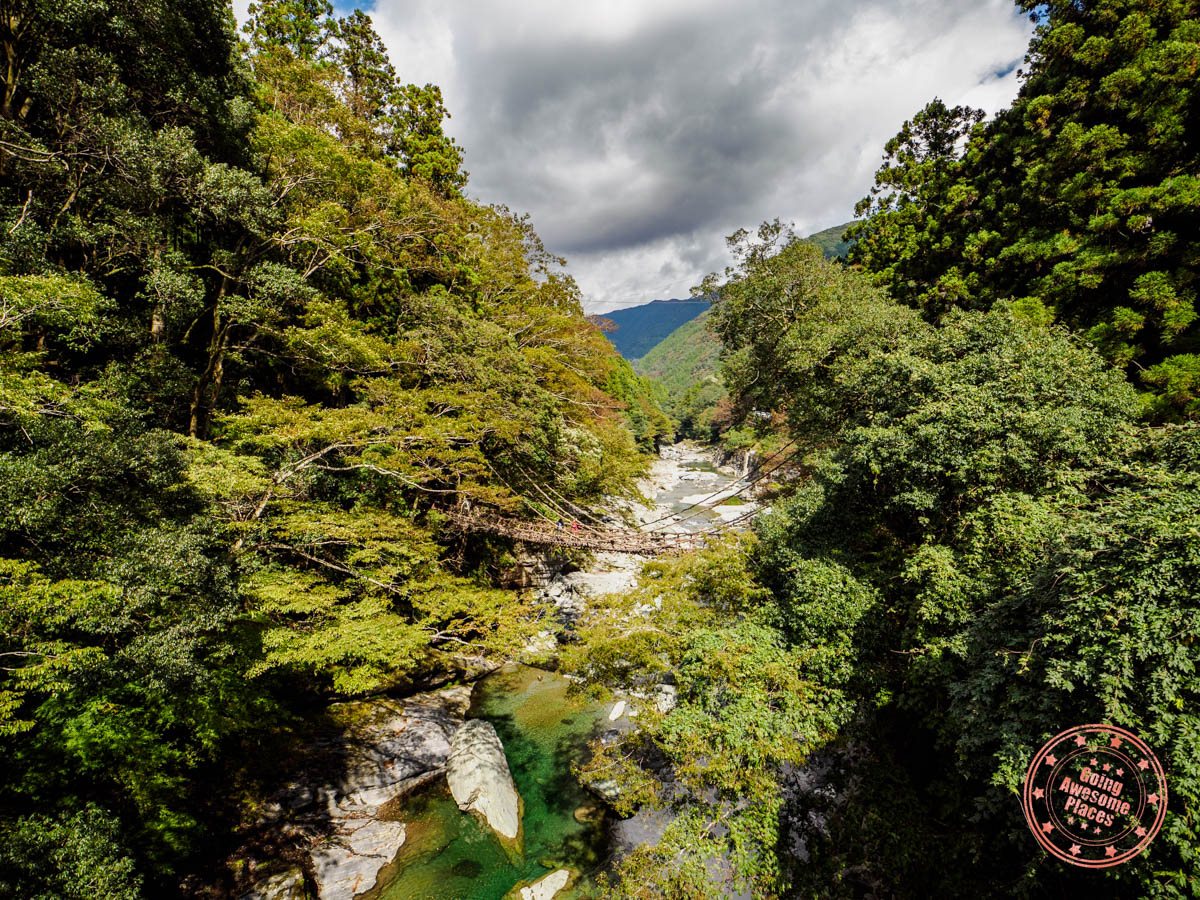
The stunning emerald Iya Valley is part of the larger Tsurugisan Quasi-National Park. The valley has a mix of nature and quaint rural towns, so whether you’re an outdoor enthusiast or a culture geek – you’ll love it!
What drew us here were the legendary Double Vine Bridges. There were once 13 in the region, but only 3 are still standing. Made of planks of wood held together by twisted vine, the gaps along the bridges are huge. Get ready to tap into your adventurous side and test your vertigo on the Oku-Iya Double Vine Bridges.
It turns out that the bridges are connected to the Heike Clan that took refuge in the valley. They built the bridges as a way to travel through the valley, but the clever thing is that they were also easy to cut down if the clan was invaded.
While you’re in Iya Valley, you 100% need to make sure you stay 1-2 nights in a traditional farm stay. We had the opportunity to stay at Kouya Farmstay where had traditional slow-cooked meals cooked over their iori floor hearth, learned how to make udon, and enjoyed epic views of the valley.
Check out the charming Nagoro ‘Scarecrow’ Village in the Iya Valley

You’re unlikely to come across anywhere like the Nagoro Scarecrow Village again. The town’s residents are outnumbered by the life-sized scarecrows 10 to 1! As you walk around the village you’ll spot scarecrows everywhere, like sitting at the bus stop and outside shops.
The craze was started by Tsukimi Ayano, a local who built a scarecrow that looked like her father and positioned it on their family farm. From there, the tradition grew in a wonderful way to keep the village’s spirit alive.
Try your hand at a traditional craft

Shikoku is famous for indigo-dying, known as aizome. The industry thrived for centuries, and it was especially prominent in the Udatsu Townscape. We were curious what all the fuss was about, so we hit the Yamauchi Studio and made our own hand-dyed bags!
It was awesome learning crafting methods that have been around for generations, and the tie-dye souvenirs we came out with are still one of our favourite travel relics.
Activities To Book In Advance
Tours are a great way to squeeze lots of attractions into a single day and will save you the trouble of having to figure out the logistics. Here are some of the coolest tours in the area that you should definitely check out.
- Day tour to Shikoku from Osaka – If you’re on mainland Honshu and you want to visit Shikoku but you don’t have much time to extend your itinerary, then this one-day tour from Osaka is a good way to see some of the highlights on a whistle-stop tour. The best time of year to book this tour is during the Awa Odori Festival, so you can go and catch some of the traditional dance shows.
- Make your own knife with a master blacksmith using traditional methods. We stopped at a knife making workshop near the Shimanto River in the Kochi mountains. The owner, Nobuya-san, uses techniques that date back 1,500 years. We spent the afternoon hammering, sanding, and grinding down steel until we had a traditional Japanese knife to take away with us.
- Join this cool Kochi Castle and Hirome Market tour – This half-day tour is the perfect way to explore Kochi. In most cases, you probably don’t need a local guide when you’re exploring a new city, but having someone there to guide you to the best market stalls at Hirome Market and to fill you in on the history of Kochi Castle is a big win.
- Tap into your adventurous side on this Shimanto river rafting tour – Get picked up in Shimanto and head out on a half-day river rafting adventure. Get your nature and adrenaline fix in one!
- Squeeze the highlights into this epic Takamatsu half-day tour – We’ve already mentioned the adorable Ritsurin Garden, but there are plenty of other things to see in Takamatsu that we haven’t put into this guide, such as the Sanuki Mingeikan museum and city castle.
- Delve into your artsy side on this Naoshima private day tour – Japan’s art island is packed with hidden sculptures and unlikely museums that you’d never find on your own. Having a tour guide will definitely be helpful!
Go Deeper In Shikoku
- Read our epic 12-Day Shikoku itinerary. This huge guide will be your Shikoku bible, where you can follow in our footsteps and read all about our favorite destinations on Shikoku. We’ve also crammed the article with top tips for each attraction and designed it as a day-by-day schedule so you can leave the planning to us and skip ahead to the fun part!
- Find out everything you need to know about the Sakura season ahead of your trip in our Ultimate Guide To Cherry Blossoms In Japan! From tips on how to predict when the cherry trees will blossom to the symbolic significance of these gorgeous trees, there’s loads in there to get you inspired. Each city in Japan has a slightly different Sakura season because of how location-sensitive the blossom season is, so make sure you get it just right with this handy guide.
- Foodies will love our 9 Tasty Snacks in Japan That Make Great Souvenirs article. Because nothing is labeled in English in Japan, figuring out what’s what is nearly impossible, so this handy guide of snacks you can buy and bring back home will help you get your bearings.
- Want to try ordering like a local on your next trip to Japan? Then check out our awesome Rosetta Stone Japanese guide, where we uncover whether the Rosetta Stone App is any good for learning Japanese. Spoiler alert – it is!
- Whether you’re a newbie backpacker or an old timer, our The Art Of Trip Planning guide is a must-read. It’s especially handy when you’re planning a trip to Shikoku, as there isn’t that much information available online.
- Don’t go to Japan before you’ve checked out our 18 Of The Best Apps For Japan Travel guide. It’s full of handy apps that will help you overcome language barriers and save you from getting lost. There used to be 12 apps on the guide, but we’ve recently extended it, so don’t miss out on our latest updates.
General Travel Tips For Shikoku
We know how tricky it can be to take a travel dream and turn it into an actual itinerary. There are endless practical details to consider, and there always seems to be something you haven’t thought about.
Don’t let the logistics bog you down, and save yourself time doing research by reading our general travel tips below.
When is the best time to go to Shikoku:
It’s hard to say exactly when the right time of year to visit Shikoku is, largely because it depends on what you’re traveling for and how you feel about big crowds. There are also some big festival dates you should keep in mind.
You might have already guessed, but the Sakura season is a busy time of year in Shikoku. From late March to early April the island’s city parks fill with travelers and locals who have come to enjoy the tradition of hanami, watching the fleeting beauty of the cherry blossom. The downside is that hotels get booked up way in advance, and prices go up.
Another popular time of year to come is during the fall season, from October to November. The leaves start to turn, and a bed of orange, yellow, and red leaves litter the ground. It’s an extra special time to visit the Kakakei Gorge!
When it comes to big festivals, Shikoku celebrates Golden Week at the end of April and the beginning of May. After that, there’s also the Obon Holiday in mid-August. We love Japanese festivals and don’t mind having to put up with the crowds, but there is a big spike in hotel and flight prices around these dates, so it’s not the best if you’re traveling on a budget.
If you’re hoping to keep your trip to a minimum cost, then you’d be better coming to Shikoku in the off-peak seasons between November and March or from May to July.
What you shouldn’t miss in Shikoku:
Shikoku has loads of great attractions for all sorts of travelers, so we’re going to break down our favorites into categories to help you get your bearings. For history and culture buffs, we recommend hitting cool sites like Matsuyama Castle, the Takaya Shrine, and catching a dance at the Awa Odori Kaikan.
Rather spend your time with your hiking boots on walking up a hill? Then head to the Kankakei Gorge, Nakatsu Gorge, and the Oku-Iya Double Vine Bridges in the Iya Valley. These were some of our personal favorites because we love getting outdoors. You will need to rent a car, unless you’re up for forking out lots of cash to pay for private tours.
There are also loads of cool art sites in Shikoku and gorgeous city parks. Set aside some time to visit Naoshima, Japan’s art island, stroll around the Sanuki Manno Park, and visit the stunning Ritsurin Garden.
One thing that every traveler should add to their Shikoku itinerary is an afternoon soaking in the historic hot springs at Dogo Onsen.
Top tips for traveling in Shikoku:
- Rent a car and travel Shikoku road trip style – There are other areas of Japan where you can rely on public transport and use trains to travel between different prefectures, but for Shikoku, we really recommend renting a car. That said, you’ll need to be extra careful when you’re driving in the Iya Valley and Nakatsu Gorge area because the roads are bendy and narrow, and a lot of the tracks are one-way.
- Download a translation app ahead of time – Because Shikoku is the least traveled area of Japan not many of the locals speak English. Get ready to spend a lot of time typing things into Google Translate.
- Remember to cover up your tattoos at Japanese onsens – The rules on tattoos in Japan are very different what you’ll be used to, and they’re pretty strict. Most onsens won’t let you in if you have large, visible tattoos on show. But luckily for you, there is a simple solution. The Suhada Seal is a sticky, skin-colored patch that you can stick directly over your tattoos to cover them up. If you’re going to visit a few different onsen towns and bathhouses, make sure you bring some spares! It’d suck to run out and have to miss out.
- Get an IC travel card – Driving in cities can be a drag, so get this handy transport card that can be used in all of Shikoku’s cities. It will save you from having to buy loads of different tickets. You can use it on buses, trains, and subways. The best part? You can use it on Japan’s other islands too!
How to get around Shikoku:
We don’t often recommend hiring a car if it can be avoided, but for Shikoku, it’s definitely the best way to get around. As the region is less popular than other parts of Japan, there are fewer transport routes. You’d also struggle to get to more remote places like the Iya Valley.
That said, having an IC Card will definitely be helpful when you’re in the region’s bigger cities. And there are options like the JR trains and buses if you can’t drive or don’t want to spend extra money on renting a car, it will just limit where you can go.
For planning your route or getting from A to B on foot, you can use Google Maps, it has reliable transport schedules and up-to-date information on traffic.
One quirky transport highlight that we couldn’t leave out is the Botchan train in Matsuyama city. The originals were from 1888, but they were recently replaced with diesel replicas in 2001 (sad, but they’re still really cool!). The trains are inspired by Soseki Natsume’s novel Botchan, so they’re an awesome historic sight.
Common travel mistakes:
- Make sure you have cash on you at all times – We’ve gotten pretty used to using our credit cards everywhere we go, but Japan is still a very cash-heavy country. Having more than you think you’ll need is always a good idea.
- Don’t forget to pack some warm layers – Shikoku’s weather can be pretty unpredictable. It goes from being sunny and warm one minute, then the wind picks up and the temperature quickly drops. Make sure you’ve got a mid-layer and some light waterproofs.
- Factor in having to pay road tolls when you’re budgeting – It’s never fun getting an unexpected charge at the end of a trip, especially as Japan is already fairly expensive. We paid ¥9,690 in tolls on our 12-Day Shikoku itinerary.
- Don’t forget that they drive on the left side of the road in Japan – That shouldn’t hold you back from renting a car, you get used to it pretty quickly. But it is worth considering if you’re a nervous driver.
What To Pack For Shikoku
This handy packing guide has everything you need for a trip to Shikoku. What are you waiting for? Get packing!
- Comfortable shoes: Your step count will quickly add up on this trip, especially when you’re visiting all the nuclear bomb memorial sites in Hiroshima. Save your feet from blisters and pack your comfiest trainers or even some lightweight hiking boots.
- If you’re visiting in the summer, you might want to consider bringing some hiking sandals so you don’t get too hot. We love Tevas and Keens most of all.
- Bring a lightweight waterproof jacket: We recommend bringing a compact jacket that you can roll and pack into your daypack (we love the Shimoda Urban Explore series), especially if you’re visiting in the autumn, as October is the rainiest month of the year in Japan.
- Always keep a mid-layer in your day bag, the temperature fluctuates a lot in Shikoku.
- Bring hand sanitizer: It’s not unusual for there to be no soap in public and restaurant toilets in Japan.
- Don’t forget your camera so you can capture all the awesome destinations you travel to! You might also want to think about packing other accessories like selfie sticks and camera hood lenses.
- Remember to pack a travel adapter: You’ll need a two-pronged Type A for Japan, so check your plugs to see if you need to get an adapter ahead of your trip. To make sure you’re covered around the world, we recommend the Mogics Super Bagel. As a heads up, if you’re from North America, note that your outlets will work in Japan.
- Order some tattoo cover-up patches ahead of your trip. You might not be allowed into Japanese onsens if your tattoos are on show. Suhada Seal’s are pretty good.
- Bring along a fast-drying microfiber towel: There’s nothing worse than having a soaking wet towel getting smelly in your bag, and they are perfect for a trip to the Dogo Onsen.
- Get some Japanese Yen ready before your trip: It’s always a good idea to pack some cash in the local currency before your trip, in case you need cash to pay for your transport from the airport or you find yourself in a sticky situation.
- Our biggest tip is to simply use the Wise card. This is because most credit cards charge a foreign exchange fee of 2.5% on top of a poor rate to begin with. With Wise, you pre-load it with JPY by converting ahead of time. This way you can do the exchange at a favourable time and you get close to market rates. It’s the only card we use when we go to Japan now.
- How much money do you need? In our 12-Day Shikoku Itinerary we estimated it costs about $208 per person per day to travel in Shikoku.
- Check if you need a Visa ahead of your trip! Most countries don’t need a Visa for a short holiday in Japan, but make sure you check the unique requirements for your country so you don’t run into any unexpected problems. You can find out more on the Ministry of Foreign Affairs of Japan website and fill this out to get your QR codes ahead of time.
An Unforgettable Trip To Shikoku Region

After spending almost two weeks traveling Shikoku, we can’t believe that it’s Japan’s least explored region.
There’s so much to see and do on the island, and thanks to it being off most travelers’ radars, you can enjoy the best of Japan without the crowds. If you’ve ever been to Kyoto during high-season, you know what we’re talking about.
Make sure you set aside some time to see the island’s coolest cultural sights, like Kochi Castle and Naoshima Island.
We’d recommend renting a car for this trip so you can reach more remote destinations like the Iya Valley but you’ll also need to take the ferries to travel around the islands of the Seto Inland Sea such as Naoshima and Shodoshima.
Frequently Asked Questions
What is Shikoku in Japan known for?
Without a doubt, Shikoku’s most famous attraction is the Shikoku 88 Temple Pilgrimage that loops around the island. It’s also known for the traditional Awa Odori Dance Festival, Iya Valley, Kankakei Gorge, and Naoshima Island.
Can you travel around Shikoku without a car?
Shikoku is theoretically doable without a car, but we think having a car will make your trip a lot simpler and save you the hassle of trying to figure out the local transport routes. That said, if renting a car is off the table, then you can use the local buses and trains.
It’s worth checking out the Shikoku Rail Pass, which is valid on JR trains and regional train companies like Kotoden, Iyotetsu, Asa Kaigan Railway, and more!
What is the best time to visit Shikoku Island?
Shikoku is a great destination year-round. The most beautiful time to visit is either in spring or autumn when the fall leaves and cherry blossom are out. The only drawback is that these are the busiest times of year. Lucky for you, Shikoku is the quietest region of Japan.
How can I get to Shikoku from Tokyo?
The best way to get to Shikoku from Tokyo is to take a flight. There is a train, but it takes nearly 6 hours. The bus is even longer, so we quickly took that off the table. To find the best flight deals, check out the Matsuyama Airport and Tokushima Airport.
How much does a trip to Shikoku cost?
One thing that’s great about Shikoku is that it’s not on the usual tourist trail. That means that hotel prices tend to be cheaper than in destinations like Kyoto and Tokyo. You can also keep your costs down by visiting outside of the peak season and sticking to budget-friendly restaurants.
It’s hard to say how much you will spend exactly, but to give you a rough idea, in our 12-day itinerary of Shikoku, when we priced out our trip to Japan and averaged $208 USD per person, per day. We found that our biggest cost was accommodations.
Japan Trip Planning Essentials And Discounts
If you’re in the middle of booking your trip to Japan, here are the most important places you need to go to book:
JR Pass
The two most reliable places we always check are JRailPass and JRPass. If you are taking long distance Shinkansen across multiple region, get the full JR Pass. If you’re focusing on one specific area, you only need a JR regional pass. The official booking platform is Smart-Ex.
Shinkansen
The JR Pass prices have gone up and for many of you, it’ll make more sense to book tickets individually. The secret is that when you buy your Shinkansen tickets through Klook offers special vouchers for Don Quijote and BIC when booking. Their tickets are super easy to redeem as well. Right now, use code SKS10OFF to save $10 USD off.
Tours
While Viator and GetYourGuide are our go-to’s, Klook and KKDay are much popular in Asia so it’s always worth comparing across all of them to make sure you get the best price. With Klook, use code GOINGAWESOMEPLACES to save up to 8% for new users and 3% for existing users.
Pocket Wifi

While we do love eSIMs, having a pocket wifi is great for sharing data with a large group. The most popular is NinjaWifi which is easy to pick up at the airport. Use code AWESOME15 to save 15% (automatically applied). Alternatives are offered by JRPass and JRailPass but they aren’t as cheap. For a more global solution, consider Solis and PokeFi.
Car Rental
Big companies such as Budget, Avis, and Enterprise operate in Japan but they’re usually the most expensive. The best companies are the local Japanese ones such as Toyota, Nippon, Orix, Nissan, and Times Car Rental. To make things easier, use Booking’s car rental platform and Klook to compare prices all in one place. Don’t forget, you need an IDP to drive in Japan so get one before you leave your home country.
Learn Japanese
It helps to know even a bit of the language before you go. Start your learning with Rosetta Stone Japanese.
Cash or Credit
Cash is still very important to have in Japan but when you use credit cards, make sure you’re not getting charged those extra exchange rate fees. The best card right now is the Wise Multi-Currency Card which is actually a debit card where you can convert at favorable rates beforehand. This cuts out any sneaky transaction fees.
Travel Insurance
Make sure you’re covered in case something happens. Get quotes from HeyMondo where booking through our link gets you 5% off automatically and if you’re from Canada, get quotes from RATESDOTCA.
Shopping
Discovering Don Quijote is a quintessential part of the Japan experience. The secret for tax-free shopping is that they have a coupon that can help you save 10% off + additional 5% off if you spend ¥10,000 or more. If you’re interested in coupons like this, we have them stored on our Goodies page that Insiders can access. Join today!














 English (US) ·