
 3 weeks ago
20
3 weeks ago
20
As someone who has been uncovering Bangkok since 2015 when I first touched down in The Big Mango to study abroad, I’ve had the opportunity to experience Bangkok like a local.
Ever since that first visit, I’ve returned to my favorite city in the world year after year to continue exploring and immersing myself in its vibrant energy. Bangkok has become a second home to me and I’m excited to share all of my insider tips with you!
From its ornate temples that transport you to another time, to its bustling markets where you can find everything from unique handicrafts to mouthwatering street food, Bangkok is a treasure trove of unforgettable experiences. With this itinerary, I’ll help you see the best of Bangkok.
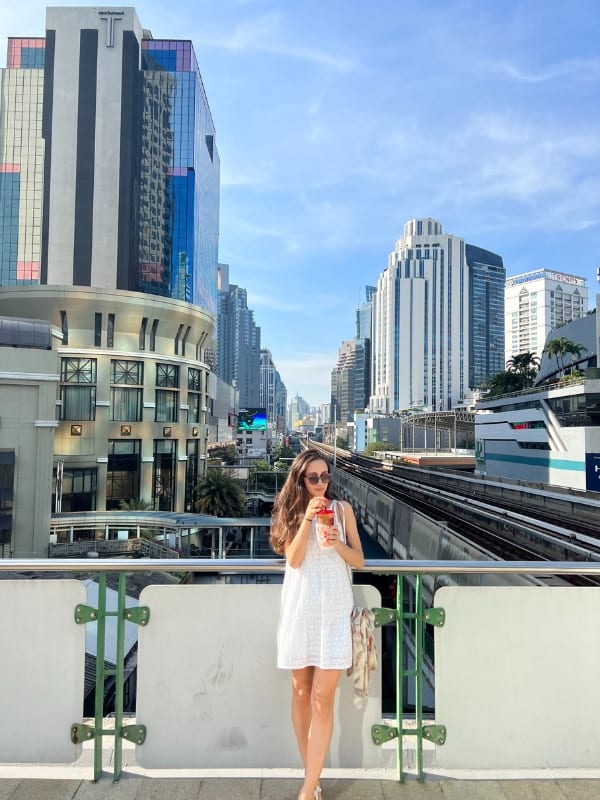

Itinerary highlights
Depending on your interests, budget, and time, I feel 4 days in Bangkok is the ideal amount for exploring the city center and having time for at least one day trip outside of the city.
However, in my 4-day itinerary I’ve prioritized the must-see sights for Day 1 and Day 2, so you can use my guide for a shorter stay focused on the highlights.
Should you have more than 4 days to spare, I’ve provided some additional activities toward the end of this guide. The table below shows my suggestions at a glance, but be sure to scroll along for all the essential details!
Top 3 most-booked experiences on Indie Traveller:
- Maeklong Railway & Floating Market day tour (€22/person)
- Muay Thai boxing match tickets (€21/ticket)
- City highlights temple and market walking tour (€19/person)
Indie Traveller editor’s picks:
- Bangkok Midnight food tuk-tuk tour (~€68/person)
- River Dinner Cruise on the Chao Phraya River (€23/person)
- Hidden Bangkok bike and food tour (€52/person)
- Kanchanaburi River Kwai & Hellfire Pass day trip (€148/person)
4 Days in Bangkok itinerary
This itinerary takes you from day 0 — the fresh off the plane, jet-lagged arrival — to day 4, by which time you’ll have had a true taste of Bangkok.
I recommend starting your trip on a weekend because key highlights like the floating markets and Chatuchak Weekend Market are open only then. But if your dates don’t line up, don’t worry! I’ve included alternative activities that are open every day.
Day 0 – Arrival in Bangkok
Get ready, because Bangkok can be a bit overwhelming at first. Traffic, pollution, and crowds can be a challenge, especially when you’re just fresh off the plane.
However, the city quickly wins you over with its culinary delights ranging from street food to high dining, temples that rise between glass towers, and locals who genuinely care. Bangkok is a city that tends to grow on visitors the more they explore.
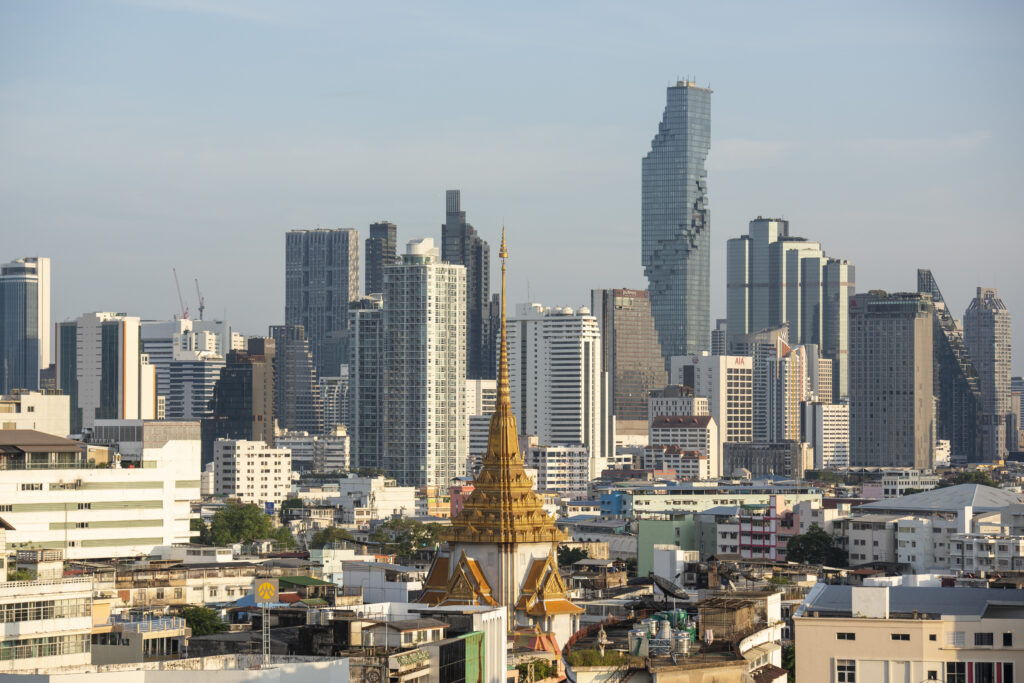 The unique mix of modern and 18th-century temples rising above Bangkok’s skyline (urf/DepositPhotos)
Use Day 0 to settle in — relax in your hotel, recover from your jet lag, or for a wander around your neighborhood. Even a walk around the block in Bangkok can be a full sensory experience, though the real sightseeing will start on Day 1.
Bangkok has two airports. If you are flying in internationally, then you will most likely land at Suvarnabhumi Airport (BKK). The smaller Don Mueang Airport (DMK) deals more with domestic and regional flights. There are several options for getting to your accommodation in Bangkok:
By airport train (cheapest)
The best option (in my opinion) is to take the Airport Rail Link, which runs from Suvarnabhumi Airport to Phaya Thai Station in the heart of Bangkok. It departs frequently, is clean, and best of all costs less than $1.00.
From Phaya Thai Station, you can hop directly on the Sukhumvit BTS (Bangkok Sky Train) Line. If you need the MRT (subway), you’ll want to get off at Makkasan Station.
Or, once you get off the Airport Rail Link, you could grab a taxi, or even a tuk-tuk if you want to start your visit off in the most fun way possible.
By taxi (most convenient)
The most convenient, albeit pricier, transportation option. Once you exit the Arrivals Hall, you’ll find taxis readily available, and the process is well-organized.
Simply take a number and wait in line for the next available taxi. It’s a hassle-free way to reach your accommodation and you won’t have to worry about any potential misunderstandings with your driver.
While fares vary depending on your final destination, you can expect to pay approximately 400-500 baht/$13–16USD for your ride.
Watch out for scams: If you take a local taxi, ensure they have a functioning meter that’s turned on as soon as the ride starts. You can politely ask for the meter before you get in and decline the ride if they don’t want to use it.
I’ve heard stories about meters being tampered with so that the fare increases rapidly for tourists who don’t know any better, so keep an eye on it. Honestly, I usually just use the Grab rideshare app (it’s the Southeast Asia version of Uber).
Grab taxis are affordable and reliable, though prone to getting stuck in Bangkok’s notorious traffic. If you’re feeling adventurous, you can order a Grab motorbike instead of a car. The local drivers will impress (or terrify) you with how easily they navigate the traffic!
Where to stay
As Marriott Bonvoy members, my partner and I recently stayed at The Surawongse and let me tell you – it was absolutely incredible. The staff was lovely, the interior was beautifully decorated in the perfect blend of traditional Thai and contemporary style, the lobby smelled heavenly, and the views from the rooftop pool were to die for. See what I mean in the photo below!
(If you want to stay at The Surawongse, sign up for the Marriott Bonvoy card to get three free nights when you meet the minimum spend.)
Below are a few other suggestions ranging from ultimate luxury hotels to budget-friendly hostels:
- COZ Ratchathewi, a budget hotel with two dorm rooms in Siam – starts from $10
- The Orientale, a highly-rated hostel in Chinatown near the MRT– starts from $30
- Jasmine Grande Residence is where I’ve stayed several times in Khlong Toei district – starts from $59/night
- Naga Residence, great for solo travellers/digital nomads and located close to the river and IconSiam Great – starts from $50/night
- Bangkok Voyage Boutique, a boutique stay with ~7 unique themed rooms, steps from BTS Ari and local cafés – starts from $60
- Oakwood Suites Bangkok offers upscale serviced apartments with a rooftop pool in Sukhumvit area – avg $141/night
Bangkok’s central areas are Sukhumvit, Silom, Siam Square, or Sathorn. They’re the perfect launchpads as they put you close to major attractions, shopping, nightlife, and are well-connected by BTS and MRT.
If you’d rather start your itinerary outside the tourist bubble, neighborhoods like Ari, Thonglor, or Phra Khanong feel more laid-back and local while still within reach of the city’s highlights.
Day 1 in Bangkok – temple hopping & markets
1. Visit the temples
Start your 4-day Bangkok trip with a temple tour! There are over 400 temples in Bangkok alone, but don’t worry, you’ll only be visiting the most famous ones (unless of course, you want to see more, then by all means, go for it).
The most impressive temples include Wat Pho, Wat Arun, and Wat Phra Kaew (Temple of the Emerald Buddha), located inside the Grand Palace.


To make the most of your temple visits, consider joining a guided tour or hiring a knowledgeable local guide who can provide insights into the history, legends, and cultural significance of at least one temple. They can enhance your experience by sharing fascinating stories and anecdotes that you wouldn’t otherwise be able to find on your own.
visit bangkok’s iconic temples
Wat Arun Ratchawararam (Temple of Dawn)
I recommend getting up early on your first day and arriving at your first stop, Wat Arun, by 8:00 AM (opening time).
This is for two reasons: the first is that the outside temperature will be pleasant, allowing you to comfortably roam around the temple grounds. The second reason is that arriving early will ensure you beat the crowds of tourists.
Nestled on the banks of the Chao Phraya River in Bangkok, stands the magnificent Wat Arun. With a history dating back over 300 years, this iconic temple showcases the captivating Khmer-style architecture that has enchanted visitors for centuries. It is certainly one of the most beautiful temples in the city, and my personal favorite!
At the heart of Wat Arun is its towering spire, Phra Pang, which soars above 70 meters in height. It’s hard to believe that up until recently, visitors were allowed to climb the steep staircase all the way to the top!
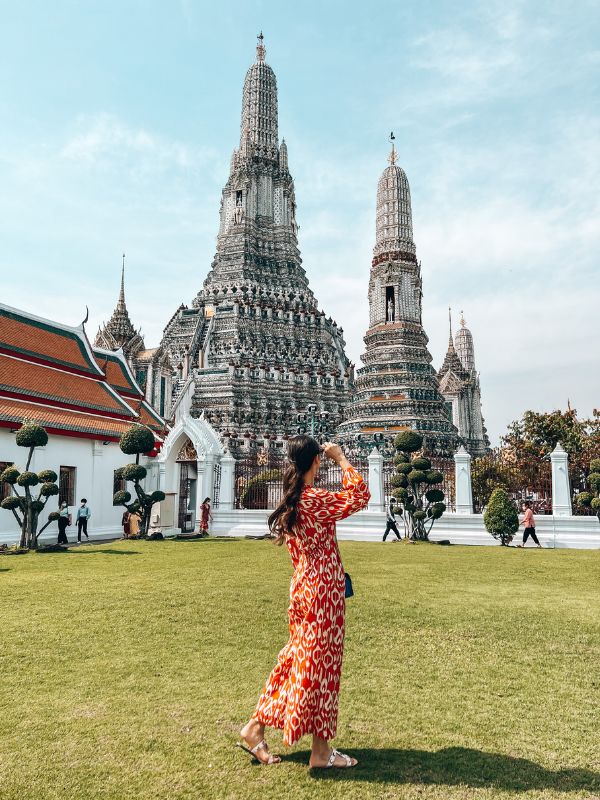
Climbing the spire is now strictly forbidden, but you can still take the stairs to the middle level of the grand pagoda, where you’ll be rewarded with stunning views of the Chao Phraya River and Grand Palace.
What truly sets Wat Arun apart from the rest of the temples you’ll visit in Bangkok is the intricate and ornate decoration adorning the spires. Covered in a mosaic of tiny seashells, beautiful colored glass, and porcelain, the temple glimmers in the sunlight creating a picture-perfect scene that has made Wat Arun a popular Instagram spot in the city.
Wat Arun is on the west side of the Chao Phraya River. Since you will most likely be staying on the east side of the river, you can ride the Chao Phraya Express Boat to the other side to reach Wat Arun. The Chao Phraya Express is a cheap commuter ferry that transports passengers up and down the river for just 15 baht ($0.45) per ride.
My Temples Tip: If you’re into temples and just want to visit one for the experience, make it Wat Saket (jump to section). Before Bangkok’s skyline filled with skyscrapers, it was one of the city’s tallest landmarks—second only to Wat Arun.
The Grand Palace & Temple of the Emerald Buddha
After admiring the brilliant architecture of Wat Arun, it’s time to cross the river to visit the crown jewel of Bangkok’s historic sites, The Grand Palace.
Constructed in 1782 when King Rama I decided to make Bangkok the new capital of Siam, this Royal Thai palace is one of the must-see sights for a 4 days itinerary in Bangkok.
While the royal family no longer lives in the palace, it is still occasionally used for ceremonies (check the official website for any potential closings).
The sprawling complex is made up of several buildings, including Wat Phra Kaew (Temple of the Emerald Buddha), which houses one of Thailand’s most sacred icons. You can easily spend 2 hours inside the palace walls, marveling at the intricate structures and the Emerald Buddha.
The Grand Palace Bangkok entry fee for foreigners is 500 baht (or ~$16usd) per person, and it is the same price for children and adults. Included are the Grand Palace, Wat Phra Kaew, and entry to the Queen Sirikit Museum of Textiles.
 (urf/depositphotos.com)
If you’re interested in exploring Bangkok’s other museums, you may want to visit the nearby Bangkok National Museum, which was the first national museum in Thailand. It is home to an extensive collection of Thai artwork and artifacts.
Additionally, the Bangkokian Museum is a lesser-known yet interesting place to visit as the perfectly preserved 1930s home gives visitors a glimpse into the lives of the Thai middle class.
Wat Pho
From the Grand Palace, cross the street to visit Bangkok’s largest and oldest temple, Wat Pho. This temple is famous for the giant reclining Buddha which is an impressive 46-meters long (it is even more magnificent in real life!).
Take your time to wander through the temple complex, enjoy the peaceful atmosphere, and of course, admire the largest reclining Buddha statue that is completely covered in gold leaf. There are several smaller temples within the complex and various structures housing historic artifacts. Plan to spend about 1 hour at Wat Pho to properly explore it.

By now, your feet will probably be tired. Luckily, Wat Pho also serves as the national headquarters for the preservation and teaching of traditional Thai medicine and massage. Pop into the air-conditioned school to cool down and relax after all of that temple hopping.
2. Get your mango fix
For an afternoon refreshment, drop by Make Me Mango, a quirky cafe serving up fun dishes with a mango twist. You can try classics like mango sticky rice and mango smoothies, or go for something like a veggie or poke bowl (with mango of course!).
3. Visit the Bangkok Flower Market
Just a short 10-minute walk away from Make Me Mango is Pak Khlong Talat, Thailand’s largest wholesale Flower Market. It’s open 24 hours a day, 7 days a week, and is a great place to dip your toes into a more local side of the city.
The market is both exhilarating and lively, and may initially seem chaotic, but it only adds to the charm and excitement of the experience.
Spend some time getting lost in the endless rows of roses, orchids, carnations, and miles of marigolds for the ultimate sensory adventure.
4. Sunset at Wat Saket (Golden Mount Temple)
Wat Saket is one of the most dazzling and beautiful places to watch the sunset in Bangkok. The 79-meter-tall white temple stands proudly atop what is the only hill in the city. This ancient temple from the Ayutthaya period is not nearly as crowded as some of the other temples in the city, which makes visiting it extra special.
320 stairs lead you to the summit where you’ll enjoy panoramic views of Bangkok. Don’t worry though, the trail is well-paved and easy to climb up. Along the path, you’ll encounter ancient prayer bells, inviting you to ring them for a touch of good fortune on your way, and about halfway up there is a small cafe where you can enjoy a refreshment.
 (iStock/watcharakornmalithong)
There’s nothing quite like sitting atop this hill as the day ends and watching the glittering lights and spires of Bangkok pass through a rainbow of colors.
5. Explore a night market
Complete your first day in Bangkok with a midnight food tuk-tuk tour. Fact is, tuk-tuk by night in Bangkok is a bucket list experience. Along this tour, you’ll hop between street stalls to taste real local food when the city is at its most alive.
If you’re doing it yourself, then head to the Talad Rod Fai Train Night Market – an absolute must-visit for any first-time visitor to the city. Located just east of Sukhumvit Road, it’s easily accessible from the On Nut BTS station by Grab or taxi. The market usually opens around 5:00 PM and closes at midnight.
The atmosphere at the market is electric, with vintage train carriages and bright neon lights creating a quirky street-style vibe that’s unlike any other Southeast Asian night market. In addition to classic street food stalls, you’ll also find food trucks, tattoo shops, old-school barber shops, antique furniture, classic cars, and other vintage collectables.


Another great night market is the Jodd Fairs Night Market in the Rama 9 neighborhood. Here you’ll find all of your night market food classics, a section for trendy clothing and accessories, and a large seating area featuring an open-air stage where nightly performances take place.
Day 2 – exploring Bangkok’s unique markets
1. Experience the Maeklong Railway Market
Escape from the city on day 2 to check off one of the most memorable places in Bangkok.
The Maeklong Railway Market, located 1 hour south of Bangkok, is a one-of-a-kind market experience. The vendors set up shop right on the railway tracks – no safety barriers or warning lights in sight. At several intervals throughout the day, vendors quickly fold up their umbrellas and stalls to make way for the train, which passes through the core of the market!
It’s an adrenaline-inducing sight to behold as the train chugs through the narrow pathway, mere inches away from the vendors’ products. In fact, the train runs so close that you could reach out and touch it! When the train finally passes, the vendors just as quickly unfold their umbrellas and resume business as usual.
 (urf/depositphotos.com)
Keep in mind that the train only passes through at specific times, and if you want to catch it, you’ll need to arrive at least 15 minutes early to secure a spot along the tracks.
The train arrives daily at: 8.30 a.m., 11.10 a.m., 2.30 p.m., and 5.40 p.m, and departs at: 6.20 a.m., 9.00 a.m., 11.30 a.m. and 3.30 p.m.
Editor’s note: This GetYourGuide market boat ride takes you straight through Thailand’s most famous markets (the floating market & the railway market) and right past everyday local life.
If you prefer to do it yourself, you can catch a minivan to Maeklong from Southern Bus Terminal (Sai Tai Mai), which is around 70 THB/$2USD one-way.
2. Cruise through a floating market
It’s time to make your way to yet another iconic site. Floating markets are special in that they are situated along rivers and canals where, traditionally, vendors would sell goods out of wooden boats on the water instead of stalls.
There are many floating markets around Bangkok, with the most popular one being Damnoen Saduak Floating Market. But if you’re looking for a more authentic experience, I suggest going to the lesser-known Amphawa Floating Market, which is also frequented by local Thais.
 Damnoen Saduak Floating Market (fokkebok/depositphotos.com)
The main draw to the floating markets is, of course, the food! Grilled prawns, fish, and other seafood dishes are all carefully prepared on the wooden boats that glide along the canals. Do as the locals do and place your order with a vendor, and once your food is done, have a seat on the concrete steps leading down to the water to devour your meal.
If you prefer a classic table-and-chair setup, Amphawa Floating Market does have restaurants a bit further away from the main bridge. Some restaurants even have balconies overlooking the water, where you can enjoy your food with the backdrop of the market.
3. Muay Thai fight in the evening
When you arrive back in Bangkok, get ready for a glimpse into Thailand’s rich martial arts history by attending a Muay Thai fight. It’s a centuries-old martial art combining striking techniques with clinching and powerful kicks, and witnessing a fight in Thailand’s capital is an exhilarating experience.
The atmosphere inside the stadium is exciting, with cheering fans, loud music playing, and locals betting on which fighter will win. One of the coolest elements of the night will be the Wai Kru Ram Muay, a ceremonial dance during which the fighters pay homage to their teacher, parents, or King.

There are plenty of places to watch a Muay Thai fight in Bangkok, and many of these venues offer tickets that can easily be purchased online or at the door. Depending on the stadium, fights are only held on certain days of the week.
You can book tickets to a Muay Thai match at Rajadamnern Stadium, or, if you’re a sports enthusiast, take a personalized, 1-on-1 Muay Thai training.
Get your muay thai tickets here
4. Find a rooftop bar
You can’t go to Bangkok without enjoying the city’s stunning skylines from a rooftop bar. There’s something extra magical about sipping a cocktail high above the bustling streets, surrounded by the glittering lights and endless sea of skyscrapers.
Bangkok is a haven for rooftop bars, and each one offers a unique experience, from sleek and modern venues to hidden gems tucked away in charming corners of the city. Sip on refreshing mojitos, indulge in exotic Thai-inspired blends, or savor a perfectly crafted martini while admiring the panoramic views.


Some of my favorite rooftop bars in Bangkok are:
- Baiyoke Sky Hotel, with 2 public observation decks. If you book a room at the hotel, you’ll get free access to both decks
- King Power Mahanakhon, home to Thailand’s tallest public observatory deck
- Tichuca Rooftop Bar
- Octave Rooftop Lounge & Bar
- Eagle Nest Bar
- Skybar at Lebua State Tower, seen in The Hangover 2
*Day 2 alternate itinerary
Day 2 on your Bangkok 4 days trip would ideally be a Saturday, as that is when the floating markets and Muay Thai fights take place.
If your visit doesn’t line up with a weekend, I suggest checking out Khlong Toei Market, which is one of the last authentic markets of Bangkok and a truly local spot.
Khlong Toei Market may not be an Instagram photo spot, but it shows what a true Thai market looks like.
 That’s me, ready to start the hidden bike tour in Bangkok!
You’ll get a real taste of Thailand as you pass by stalls selling loads of fruits and vegetables, live frogs, obscene amounts of dried fish, crates of eggs stacked sky-high, and extremely fresh chicken (if you’re pickin’ up what I’m throwin’ down).
After your market visit, journey over to the west side of the Chao Phraya River for a hidden Bangkok bike and food tour. Your local guide will take you deep into the hidden, old Bangkok that 99% of tourists have never seen. This tour will have you traveling like a local while riding through narrow backstreets and stopping to eat tasty Thai food along the way.
Hidden bangkok bike & food tour
Day 3 in Bangkok – urban explorations
1. Stroll through Bangkok’s famous parks
Begin the morning of your third day in Bangkok by making your way to the city’s most iconic green space, Lumpini Park (also spelled Lumphini Park). I recommend going early, between 7:00 AM and 9:00 AM.
Not only will it be cooler in the morning, but this is also the time when you will see the most people in the park. It’s fun to people-watch as locals go for their morning jog, partake in outdoor aerobics classes, and even practice dance routines.
Wandering through Lumpini feels surreal as the park is incredibly peaceful and lush, despite being smack dab in the heart of Bangkok and surrounded by skyscrapers.
Walk around the large fish ponds to try and spot the humongous monitor lizards swimming, or find a seat in the shade to enjoy a take-out coffee from one of the countless cafes surrounding the park (or pick one up from 7/11!).
If you’re up for a bit more exercise, move through the park toward the northeast corner where you’ll find the entrance to the Lumpini-Benchakitti Park Walkway (also known as the Green Mile). This 2-kilometer stretch is a well-paved overpass that connects Lumphini Park to the newer and majestic Benjakitti Forest Park.
 The monitor lizards at the Lumpini Park
The path cuts through the city over roads and khlongs, giving you a glimpse into Bangkok’s daily life. From the verdant parks on either end to Thai homes crowded along the canals below, this pathway will completely immerse you in the authentic charm of Bangkok.
The path itself is separated into a walking lane and a bike lane, and there is even a small shop along the overpass where you can grab a refreshment from.
2. Shop at Chatuchak Weekend Market
After you’ve gotten in your morning exercise, it’s time to make your way to what is considered to be one of the largest markets in the world – the Chatuchak Weekend Market. This sprawling market is spread out over 35 acres and consists of no less than 15,000 stalls!
While it may seem overwhelming, the market is very well organized and easy to navigate – although it will take you several hours to make it through the maze of stalls if you want to see everything.
Anything that you can think of you can and will probably find at Chatuchak Weekend Market. You’ll see vendors selling handicrafts, souvenirs, antiques, wooden products, furniture, ceramics, clothing, footwear, accessories, and even pets.
Luckily, the market has plenty of food options for when you get hungry from all that shopping. While the market is outdoors, they have recently added an indoor, air-conditioned section where you can pop in and cool off. Chatuchak is popular with both locals and tourists and is open on Saturdays and Sundays from 9:00 AM to 6:00 PM.
3. Explore Chinatown and the Talad Noi District
No trip to Bangkok would be complete without a visit to Chinatown. So to end day 3, take the MRT to Hua Lamphong station to explore the Talad Noi District first. This historic riverside neighborhood is still a bit under the radar, which makes visiting it that much cooler since not many tourists venture to this part of the city.
This primarily Chinese neighborhood is lined with repair shops and stores selling car parts. Tucked between these places are old temples, beautiful street art, and hip cafes housed in former factories and garages. It’s such an eccentric area of Bangkok, and definitely worth taking a stroll around.
Get your afternoon caffeine fix with a perfectly brewed coffee at Mother Roaster’s or grab a bite to eat at Hong Sien Kong Cafe (also a gorgeous spot to watch the sunset).


When night falls, walk over to Chinatown, one of Bangkok’s most vibrant districts. Chinatown is a melting pot of Chinese culture and Thai charm. Stepping into this bustling neighborhood, you’ll find yourself surrounded by a whirlwind of sights, sounds, and enticing aromas. It truly is a feast for the senses.
Make your way down Yaowarat Road, the main avenue that runs through Bangkok’s Chinatown. There, you’ll find an array of incredible street food, historical buildings, and lots of shopping opportunities (Yaowarat Road is also a great place to buy gold if you’re looking for a special souvenir).
You can walk all the way to Ong Ang Walking Street, one of Bangkok’s newest attractions. This area runs along both sides of the khlong “Ong Ang” and is decked out in string lights and interesting street art. The walking street also features live music, boating on the canal, a market, and of course, plenty of Thai food.
*Day 3 alternate itinerary
If your stay in Bangkok doesn’t align with a weekend, you unfortunately won’t be able to visit the Chatuchak Weekend market. But don’t worry, there are plenty of other things to do!
For instance, embark on a captivating journey into Thailand’s ancient history with a day trip to the ancient city of Ayutthaya. Built in 1350, served as the capital of Siam for several centuries before it was burned down in 1767.
Today, it is a UNESCO World Heritage Site, and remnants of the once-glorious city can be witnessed at the Ayutthaya Historical Park just a one-hour drive north of Bangkok. Strolling among the temple ruins will transport you into the past as you admire the intricate brick and stone architecture, towering prangs, and serene Buddha statues that have withstood the test of time.
You can get to Ayutthaya by train or bus, but joining this tour to Ayutthaya includes a hotel pickup and is the easier way.
Day 4 in Bangkok – wrapping up with the top spots
1. Jim Thompson House
On the last day of your 4-day Bangkok itinerary, begin your morning at the Jim Thompson House. This historic house-turned-museum provides a fascinating glimpse into the life of Jim Thompson, an American businessman who played a pivotal role in reviving the Thai silk industry.
Surrounded by lush gardens, ponds, and tropical flowers, the Jim Thompson House is a peaceful oasis in the heart of bustling Bangkok. While touring the house, you’ll learn about Jim Thompson’s efforts in revitalizing the Thai silk industry, and how silk is produced, as well as view his impressive collection of Southeast Asian art and artifacts.

In the on-site shop you can find an extensive range of high-quality silk products (unlike the “silk” products you’ll come across at the markets). From scarves and ties to clothing and home decor items, the shop provides an opportunity to take a piece of Thai silk craftsmanship home with you.
2. Go shopping at Siam Square
Now it’s time to dive straight into Siam Square, one of Bangkok’s most dynamic and bustling shopping districts. Located in the heart of the city, Siam Square is known for its trendy boutiques, modern malls, and endless shopping options that cater to every taste and budget.
Head to Siam Paragon for a world-class shopping experience. From renowned international designers to exclusive Thai labels, you’ll find an array of stylish clothing, accessories, and lifestyle products to indulge in.
If you’re looking for a diverse range of shopping choices under one roof, head to MBK Center. This multi-story mall is a treasure trove of bargains, with countless stalls and shops selling everything from high-end dupes and accessories to electronics and souvenirs. This is a great place to score some good deals!


When in Siam Square, don’t miss the chance to stop into the 9th largest shopping mall in the world – centralwOrld. With over 500 stores spanning 8 stories, centralwOrld is a massive mall with a huge variety of stores and restaurants to choose from.
If you still have it in you after all that shopping, head across the river to ICONSIAM, one of the biggest malls in Asia that even houses the world’s only indoor floating market! You’ll find high-end stores here, a lovely terrace with panoramic views of the city skyline, and a fountain show in the evening.
Needless to say, ICONSIAM is quite the spectacle and is definitely worth the visit. Plus, you can get there for free using the ICONSIAM free shuttle boat that departs regularly from the Sathon Pier.
3. Party on Khao San Road
End the day by heading to the famous Khao San Road, the legendary backpacker hub of Bangkok. This tiny street is bursting with bars, buckets of cocktails, exotic street food, and loud music. It’s where you can enjoy a cold beer or cocktail while mingling with fellow travelers from around the world.
It is important to note that while Khao San Road is well-known for its lively atmosphere, it may not be for everyone.

Other cool things to do in Bangkok
Have extra time in Bangkok? You can easily extend your itinerary with any or all of the following activities.
Take a cooking class
Immerse yourself in the flavorful world of Thai cuisine by joining a cooking class! Cooking with Poo is a class in Bangkok that offers visitors the opportunity to learn the art of Thai cooking from a remarkable woman named Poo.
Poo will take you to the local market to pick up ingredients and teach you about the different types of fruits, vegetables, herbs, and proteins used in Thai cooking.
After that, you’ll head to Poo’s house where she guides you through the preparation of traditional dishes from aromatic curries to savory and sour soups.
Beyond the cooking experience itself, the class takes place in Klong Toey (Bangkok’s largest slum), giving visitors a chance to witness a different side of the city. It’s an eye-opening experience that goes beyond the typical tourist attractions and allows you to appreciate the richness and diversity of Thai society.
Visit Poo’s website to read more about her cooking school and book a class while you’re in Bangkok!

Visit Erawan Museum
A few extra days in Bangkok will give you time to explore some unique sites beyond the city limits. One place that’s worth visiting is the Erawan Museum, located south of the city center.
This captivating museum offers a fascinating experience that combines art, culture, and spirituality. You’ll be able to easily spot it by its eye-catching architecture depicting a three-headed elephant statue that sits atop a pink building.
The gardens here are pleasant to walk through and you can enter the museum to walk up the intricate staircase leading up to the head of the elephant. The gorgeous stained glass ceiling inside also makes for some great Instagram photos!
To get to the Erawan Museum, take the BTS Green Line all the way to Pu Chao station. From there, you can take a taxi or a Grab for the remaining 1.3 kilometers to the museum.
Check out the Asiatique mall
If you’re looking for a spot that combines shopping, dining, entertainment, and stunning riverside views, then Asiatique is the place to be. This open-air, riverside mall offers an extensive range of shopping opportunities from trendy fashion and accessories to unique handicrafts and souvenirs. But it’s not just about shopping – there’s so much more to explore here!
Take a ride on the iconic Asiatique Sky ferris wheel and be treated to breathtaking views of the cityscape and the glittering lights of Bangkok. This is the highest ferris wheel in Bangkok, reaching 60 meters in height, allowing you to truly soak up the skyline. Asiatique also has a merry-go-round and a haunted house ride, making it a fun place to come with children.
When you get hungry, choose from over 40 different restaurants and eateries, all serving up a variety of international dishes. As for entertainment, Asiatique offers a cabaret show, a puppet theater, and a Muay Thai show.
Even if you don’t buy anything, Asiatique is a wonderful place to go for a leisurely evening walk as there is always something fun going on here.
Visit Bangkok’s urban jungle – Bang Krachao
Bang Krachao (sometimes spelled Bang Kachao) is an artificial island in the middle of the Chao Phraya River. This urban jungle is relatively unknown to tourists but is a hidden gem worth exploring for adventurous travelers.
Just a short 2-minute ferry ride away from Bangkok, Bang Krachao offers a refreshing escape from the hustle and bustle of the city. With its lush greenery, peaceful canals, and cycling-friendly paths, this oasis is a paradise for nature lovers.
Trust me when I say that you’ll forget you’re in one of the busiest cities in the world!
 Phra Pradaeng — a massive green area and home to Bang Krachao’s parks, bike trails, and lush greenery
When you arrive in Bang Krachao, you can rent a bike right at the pier for only 50 baht/$2usd per hour. Pedal your way through the leafy pathways, passing by traditional wooden houses, fruit orchards, and serene temples.
I recommend this 4-hour small-group bike tour which begins with a long-tail boat to cross the Chao Phraya River then takes you through lesser-known areas around the Bang Krachao area and beyond.
Day trip to Kanchanaburi
The riverside town of Kanchanaburi is an ideal destination for a day trip, offering a mix of history, natural beauty, and cultural attractions. The trip from Bangkok used to take 3-4 hours, but thanks to a new road this was reduced to just one hour in 2026, making it an even better daytrip destination.
This province gained international recognition thanks to the movie “The Bridge on the River Kwai,” which immortalized the infamous World War II railway bridge and the harrowing events surrounding its construction.
Today, visitors can walk across the historic bridge, learn about its dark past at the nearby museums, and pay tribute to the lives lost during the war. In addition to its historic significance, the Kanchanaburi province boasts epic landscapes and serene surroundings including Erawan National Park.
You can reach Kanchanaburi from Bangkok by taking one of the many day trips offered to the region. For example, this private Kanchanaburi tour offers a full-day guided tour of the region’s highlights, covering Hellfire Pass, the Kanchanaburi War Cemetery, JEATH War Museum, and the famous bridge. Plus, lunch, water, pick-up and drop-off are also included in the price.
Alternatively, you can organize this trip on your own by taking the train from Bangkok to Kanchanaburi. It runs twice per day and departs from the Bangkok Thonburi station. This standard, commuter-style train has bench seating and the journey takes about 2.5 hours to reach the station in Kanchanaburi.
How to navigate Bangkok
Despite its vast size, navigating Bangkok is surprisingly convenient and budget-friendly, thanks to the city’s extensive transportation options. Whether you’re a first-time visitor or a seasoned traveler, you’ll find it relatively easy to get around and explore.
The cheapest and most efficient option will be Bangkok’s excellent public transportation system. Depending on your current location and where you want to go, you can choose between the BTS Skytrain or MRT subway. The MRT circles around the city center, while the BTS lines run in several different directions, occasionally intersecting with the MRT.
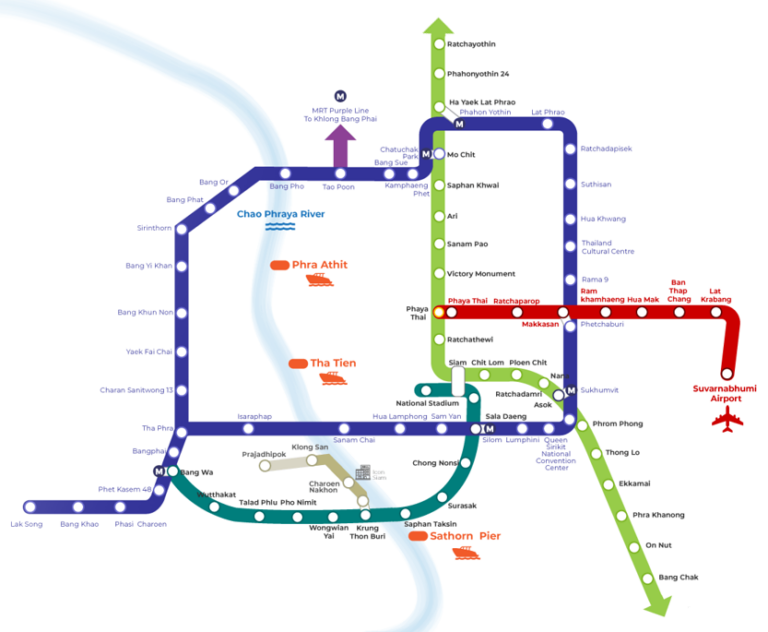 The dark blue line that forms a circle around the city center is Bangkok’s MRT subway.
Fares for the BTS and MRT are charged by distance, although most rides will cost you less than $1.00. It is important to know that tickets for the BTS and MRT are not interchangeable (you will get a paper ticket for the BTS and a plastic token for the MRT).
Another fast and easy way to get around is to use the canal boats which are inexpensive and run every 5-10 minutes.
Finally, you can get around via tuk-tuk or taxi. These last two options will be the most expensive, and depending on traffic, take the longest.
Tuk-tuks tend to be pricier than taxis, but that’s mostly because they are a tourist attraction (and are actually a lot of fun to ride).
These three-wheeled vehicles, often adorned with colorful decorations, can navigate through narrow streets and offer a unique way to immerse yourself in the bustling cityscape. There are no posted rates for tuk-tuks, so be sure to negotiate with your driver before taking a seat.
Taxis provide a good option for getting around and are convenient in the sense that you don’t have to worry about getting off at a certain stop or switching to another BTS or MRT line.
If you do decide to take a taxi, make sure it is metered before getting inside. I’d actually suggest downloading the Grab Taxi app, which will allow you to preview the price and time it will take you to reach your destination.
With such a wide range of transportation options available, exploring Bangkok on a budget is a breeze. Whether you choose to ride the efficient Skytrain, navigate the canals, or go on a tuk-tuk adventure, you’ll find that getting around the city will be an exciting part of your Bangkok experience.
What’s next on the map after Bangkok
Bangkok might pull you in with its noise and neon, but, for most, it’s rarely where the journey ends. Once you’ve had your fill of street food, market hunting, and skyline views, the road keeps going — north into the mountains or south to the islands.
I recommend this Bangkok to Chiang Mai itinerary for a journey through northern Thailand’s temples, hills, and night markets — and along the way, don’t miss Chiang Dao, a little-known gem worth pinning on your map.
Or drift west to Kanchanaburi, where waterfalls, WWII history, and river adventures await.
For a broader plan, check out these 2 to 4-week Thailand itineraries. They will help you stitch together the country’s chaos, culture, and island downtime without losing your mind!
Are you ready to embark on an unforgettable adventure in Thailand’s capital? Then pin this post or bookmark it and use it as your roadmap for a truly extraordinary 4 days in Bangkok.
The author Olivia has visited and lived in Bangkok, letting her experience the city known as The Big Mango like a local. She currently blogs at Inspired by Croatia.






 English (US) ·