
 1 month ago
33
1 month ago
33
My mum grew up in Liverpool, my godmother still lives there, and I’ve been over a handful of times across the years, most recently in 2023. So before I put this two day Liverpool itinerary together, I already knew the thing that matters most about planning a visit right now: the waterfront is in the middle of a huge transformation, and some of its most famous museums are closed. For years, not weeks.
Two days is a good amount of time for a first visit to Liverpool. It’s enough for the Royal Albert Dock and the Beatles sights on day one, the two cathedrals and the Georgian Quarter on day two, and an evening or two of eating and music in between. The city centre is compact and flat, so you can do almost all of it on foot.
The complication is that Liverpool in 2026 is not the Liverpool most guidebooks describe. The Merseyside Maritime Museum and the International Slavery Museum are both closed until 2029. Tate Liverpool’s dock building is closed too, though the gallery itself is very much still going, just in a different building. This itinerary is built around what’s actually open, with walking times between every stop so you know exactly what you’re committing to.
What’s Open and What’s Closed in Liverpool Right Now
Let’s deal with this first, because it changes how you plan your days. As of July 2026, here’s the state of play on the waterfront:
The two closed museums are part of a £75 million redevelopment of the waterfront, and they’ve been closed since January 2025. National Museums Liverpool say both are due to reopen in 2029, so if your plan for day one was built around the Maritime Museum, you’ll want a new plan. That’s largely what this article is for.
The Tate situation confuses a lot of visitors, so to be clear: the gallery didn’t leave Liverpool. The famous dock building closed in October 2023 for redevelopment (the reopening is currently expected in 2027, per press reports, though Tate themselves haven’t committed to a date), and in the meantime the collection is showing at RIBA North on Mann Island, a few minutes’ walk along the waterfront. It’s free, and it’s open seven days a week, 10am to 5.50pm.
One more thing on the free museums: they’re closed on Mondays outside school holidays. During the summer holidays and other school breaks they open seven days, so for most summer visitors this won’t matter at all. If you’re visiting on a Monday outside the holidays, check the day you’re going, and remember the Tate at RIBA North opens every day regardless.
Day 1 in Liverpool: The Waterfront and the Beatles
Day one covers the thing Liverpool is most famous for (the Beatles) and the place the city is most proud of (the waterfront). Everything on this day sits within a short walk of everything else.
Morning: Royal Albert Dock
Start at the Royal Albert Dock. If you’re coming from Lime Street station, it’s a 15 to 20 minute walk through the city centre via Church Street and Liverpool ONE. Alternatively, take the Merseyrail loop one stop to James Street (about 2 minutes), and it’s a 5 minute walk from the platform to the dock.
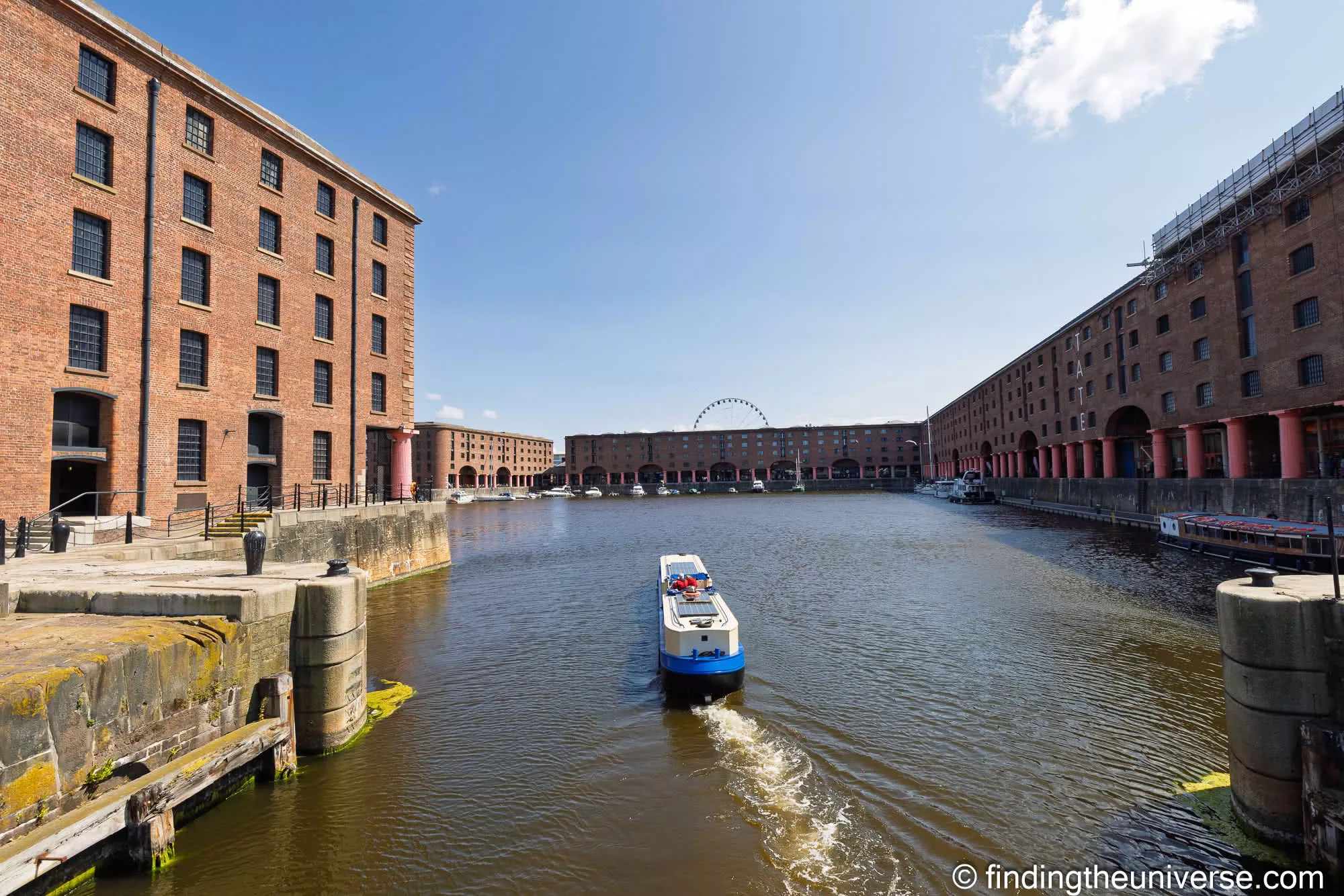
The dock is the centrepiece of Liverpool’s maritime waterfront: five huge Victorian warehouses around a rectangle of water, and all five are Grade I listed. These days they hold shops, cafés, galleries and museums. Give yourself half an hour or so to walk the perimeter before anything opens, because the colonnades and the water are the best free sight in the city.
You’ll also see the redevelopment work I mentioned above. The Maritime Museum and International Slavery Museum buildings are closed off, and will be until 2029. It’s still well worth coming here, but I want you to arrive knowing that, rather than finding out from a sign.
The Beatles Story
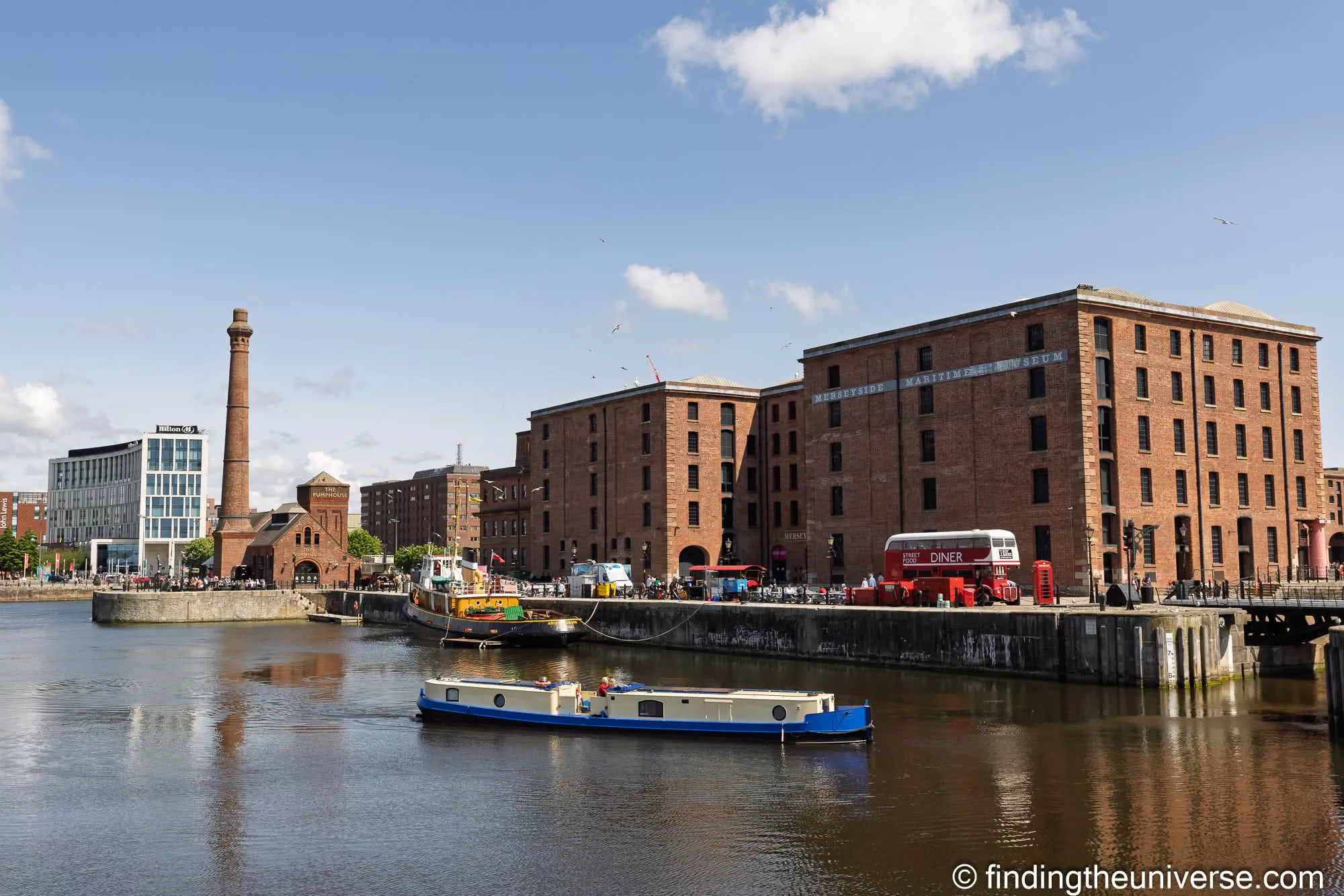
The Beatles Story sits at the south end of the dock, and it’s the city’s headline Beatles attraction. It takes you chronologically through the band’s story with a good audio guide, recreations of key locations, and a lot of original items. We spent getting on for two hours in here, and fans could easily spend longer.
Entry is by timed slot, so I’d book your Beatles Story ticket in advance, especially in summer. Tickets are £20 for adults, £16 for seniors and students, and £11 for children aged 5 to 15.
From March to September it’s open daily 9am to 6.30pm, with last entry at 5pm. Winter hours are shorter, so check the opening times page if you’re visiting between October and February. One practical note: they don’t accept cash.
My own Beatles credentials are thin, but I do have one: I once spent time on the same tiny Seychelles island as Paul McCartney. He was on honeymoon. I lived there. We did not form a band.
Afternoon: Tate Liverpool at RIBA North and the Museum of Liverpool
For lunch you’ve got plenty of options at the dock itself, or hold on until the evening for the food market I’ll get to shortly.
Then it’s a 5 minute walk north along the waterfront to Mann Island, 425m away, where Tate Liverpool is currently showing its collection at RIBA North while the dock building is redeveloped. It’s free, it’s compact, and it’s open every day of the week, which makes it the most reliable gallery stop in the city.
If you only know the Tate from its old warehouse home, this is a very different, smaller experience, but the art is real Tate collection material and a visit takes a bit under an hour.
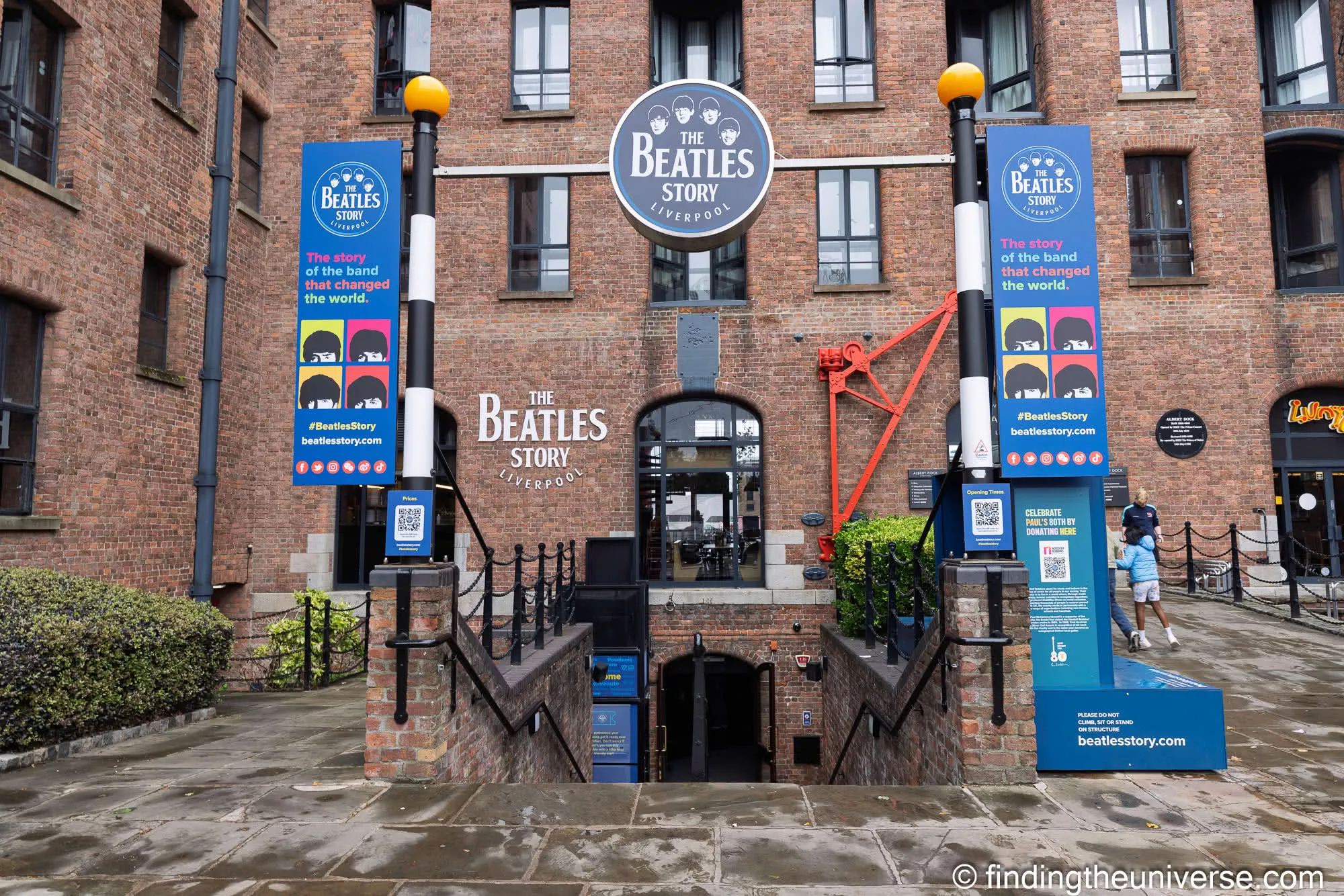
Next door, the Museum of Liverpool on Pier Head tells the story of the city itself: the port, the people, the music, the football. It’s free, and it’s the museum I’d pick if you only do one indoor stop today. It’s open 10am to 5pm Tuesday to Sunday (plus Mondays in school holidays). Allow an hour to an hour and a half.
Pier Head and the Royal Liver Building
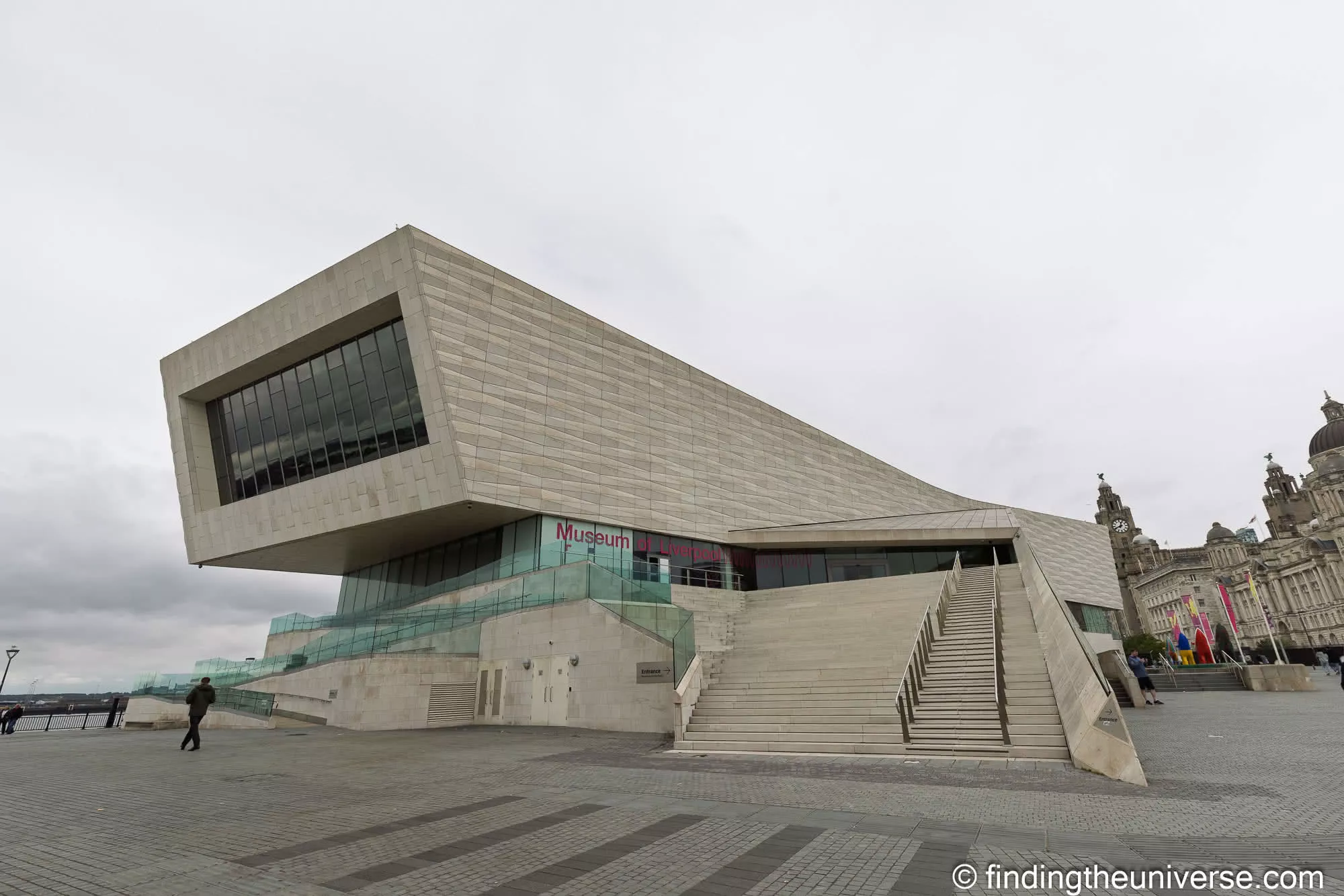
Right outside the Museum of Liverpool you’re on Pier Head, home to the Three Graces: the Royal Liver Building, the Cunard Building and the Port of Liverpool Building. This is the classic Liverpool waterfront view, and the Beatles statue is here too, permanently mid-stride and permanently surrounded by people doing the same walk for photos.
If you want to get up high, Royal Liver Building 360 runs guided tours up the building, finishing by the famous Liver Birds with a view along the whole waterfront. The tour lasts 70 minutes, plus around 30 minutes for the visitor centre, and costs £18.50 for adults and £13 for children (plus a £1.75 admin charge per booking).
A couple of things to know: there are 124 stairs above the 10th floor, under 5s can’t go up, and tour times vary by season and demand rather than following fixed published hours, so check availability and book ahead, particularly at peak times when it does sell out.
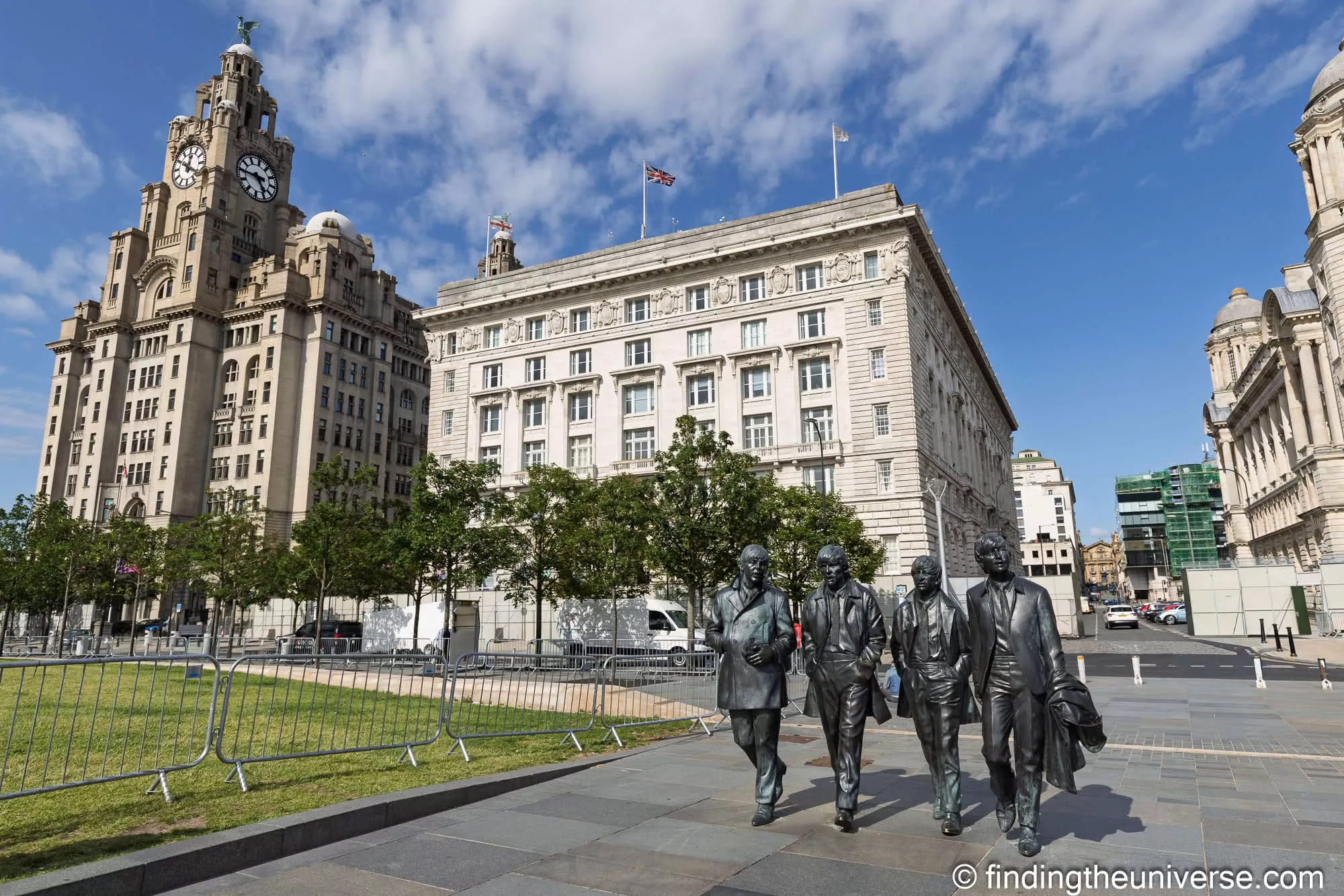
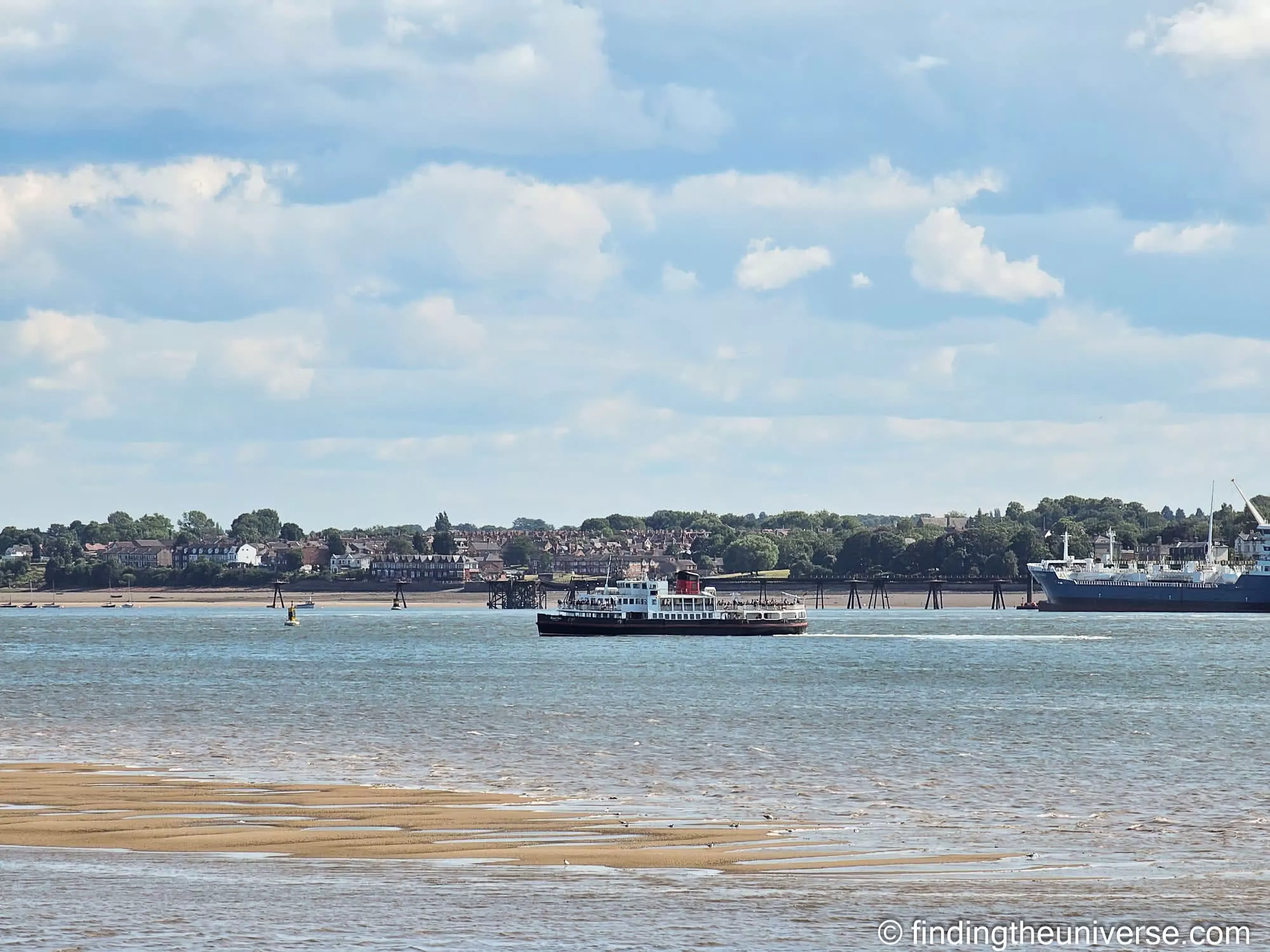
The alternative way to see the waterfront is from the water. The Mersey Ferries River Explorer cruise is a 50 minute loop with commentary, departing from the Gerry Marsden Terminal at Pier Head roughly hourly through the middle of the day. The exact timetable is seasonal, so check before you plan around it, and check current fares on the Mersey Ferries site or book the River Explorer cruise online. Tickets bought online are valid for 12 months from purchase, which is a really nice touch if your plans shift. Tickets bought at the terminal are for that day only.
If it’s a choice between this and the Liver Building tour, I’d let the weather decide: the ferry on a clear day, the building when it’s grim.
Evening: Mathew Street and the Cavern Quarter
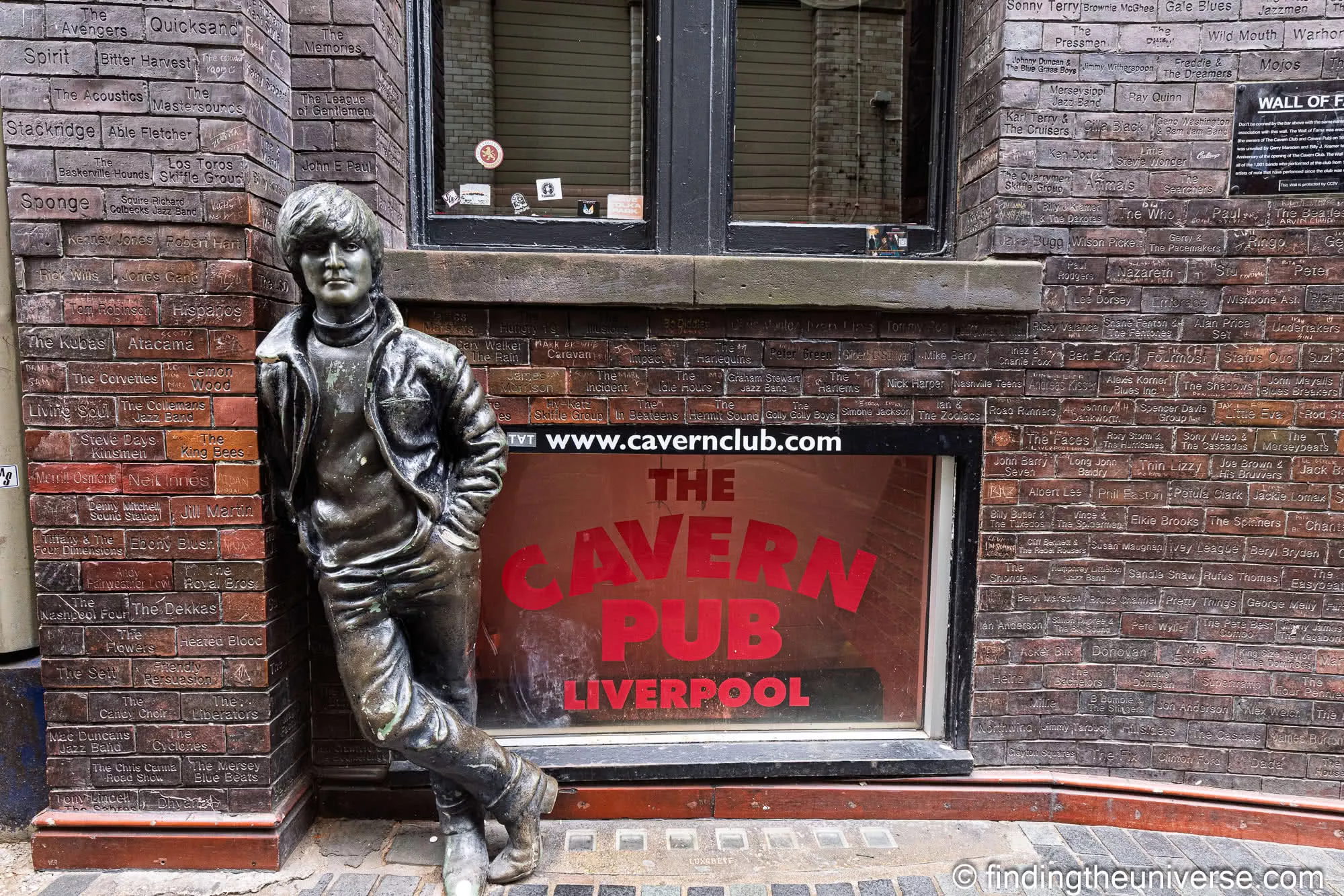
From Pier Head it’s a 10 to 15 minute walk into the Cavern Quarter, the compact grid of streets around Mathew Street where the Beatles played their early Liverpool shows. The Cavern Club still runs live music every day, and the surrounding streets are wall to wall with Beatles pubs, statues and memorabilia shops.
It’s touristy, of course, but it’s the good kind of touristy, and an evening of live music here is the right way to end a Beatles-themed day.
Day 2 in Liverpool: Two Cathedrals and the Georgian Quarter
Day two swaps the waterfront for the city’s other great architectural set pieces: two enormous and completely different cathedrals, connected by one of the best streets in England, with a museum morning to start and a food market to finish.
Morning: William Brown Street
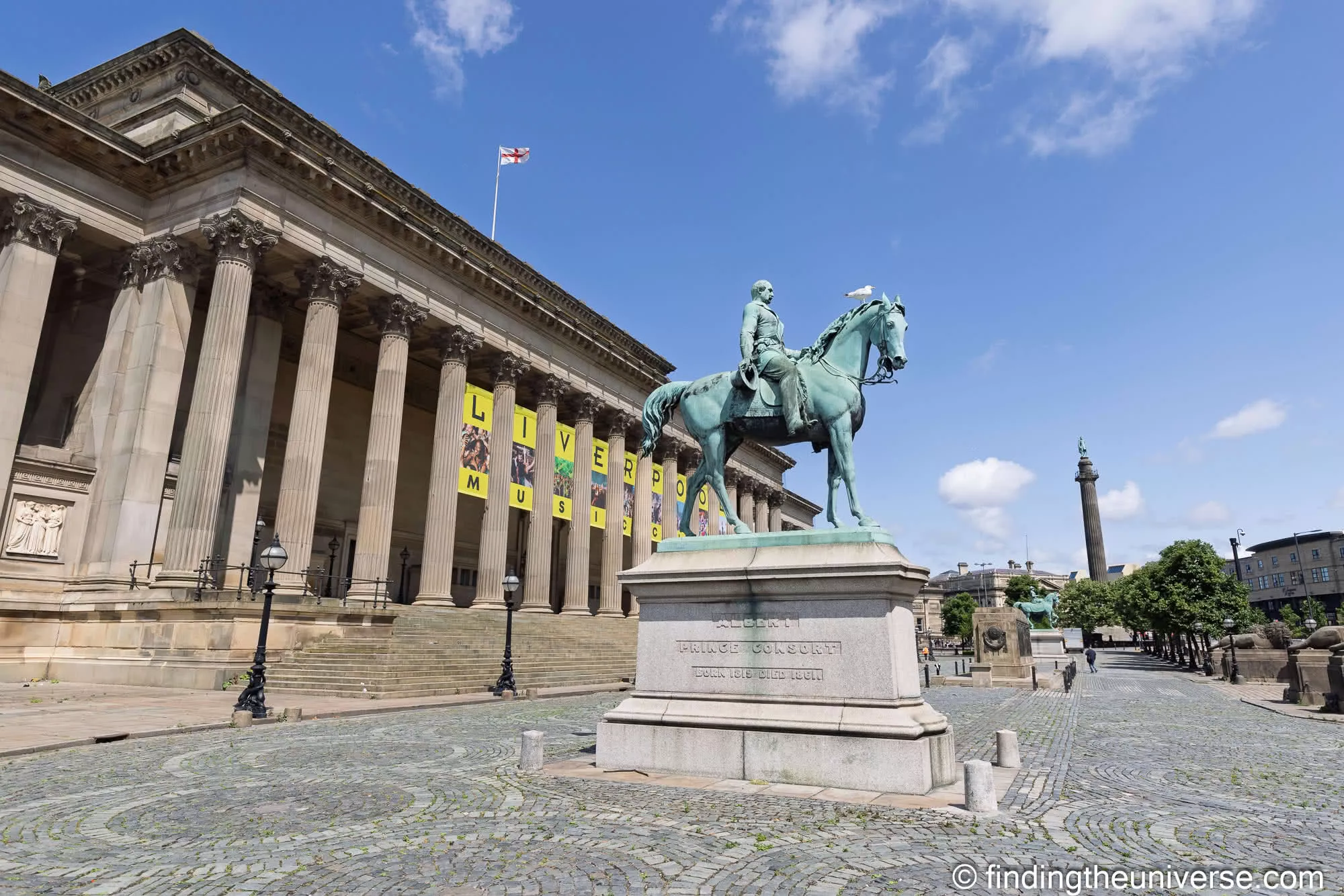
Start on William Brown Street, a five minute walk from Lime Street station, where the city’s grandest 19th century civic buildings stand in a row. Two of them are free national museums: the Walker Art Gallery, which holds one of the largest art collections in England outside London, and the World Museum, which covers everything from Egyptology to a planetarium and is a very good shout if you’ve got kids.
Both are open 10am to 5pm Tuesday to Sunday, plus Mondays during school holidays. With one day-two morning, I’d pick one rather than rushing both. The Walker if art is your thing, the World Museum if it isn’t. St George’s Hall, directly opposite Lime Street, is worth a look from the outside either way, even if you don’t go in.
The Metropolitan Cathedral
From William Brown Street, it’s around a 15 minute walk up to the Metropolitan Cathedral of Christ the King, Liverpool’s Catholic cathedral. It’s a striking 1960s building, circular, concrete and crowned with a lantern tower of stained glass, and locals have called it “Paddy’s Wigwam” for as long as anyone can remember. Step inside: the coloured light in the central space is the point, and entry is free.
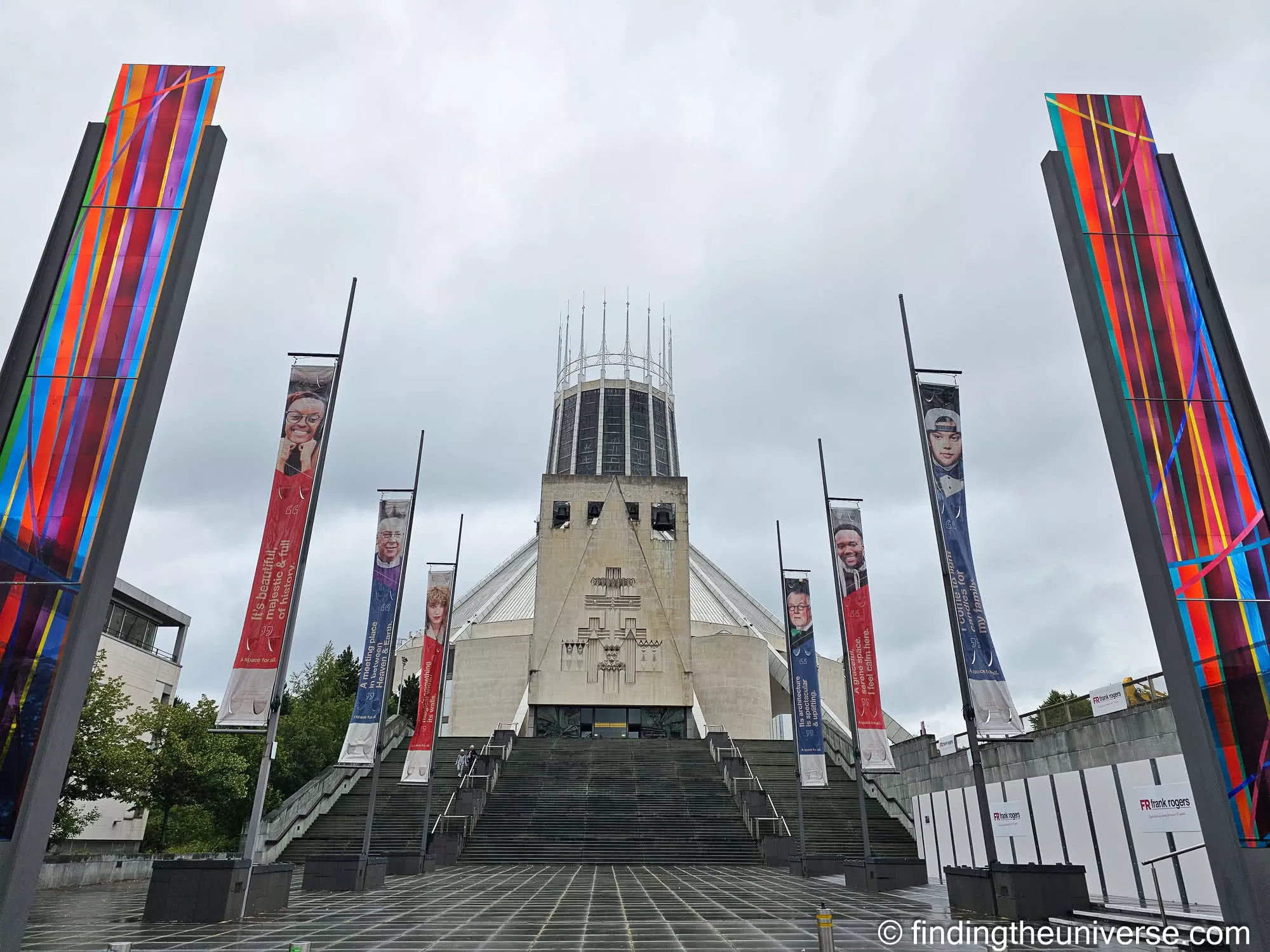
Hope Street
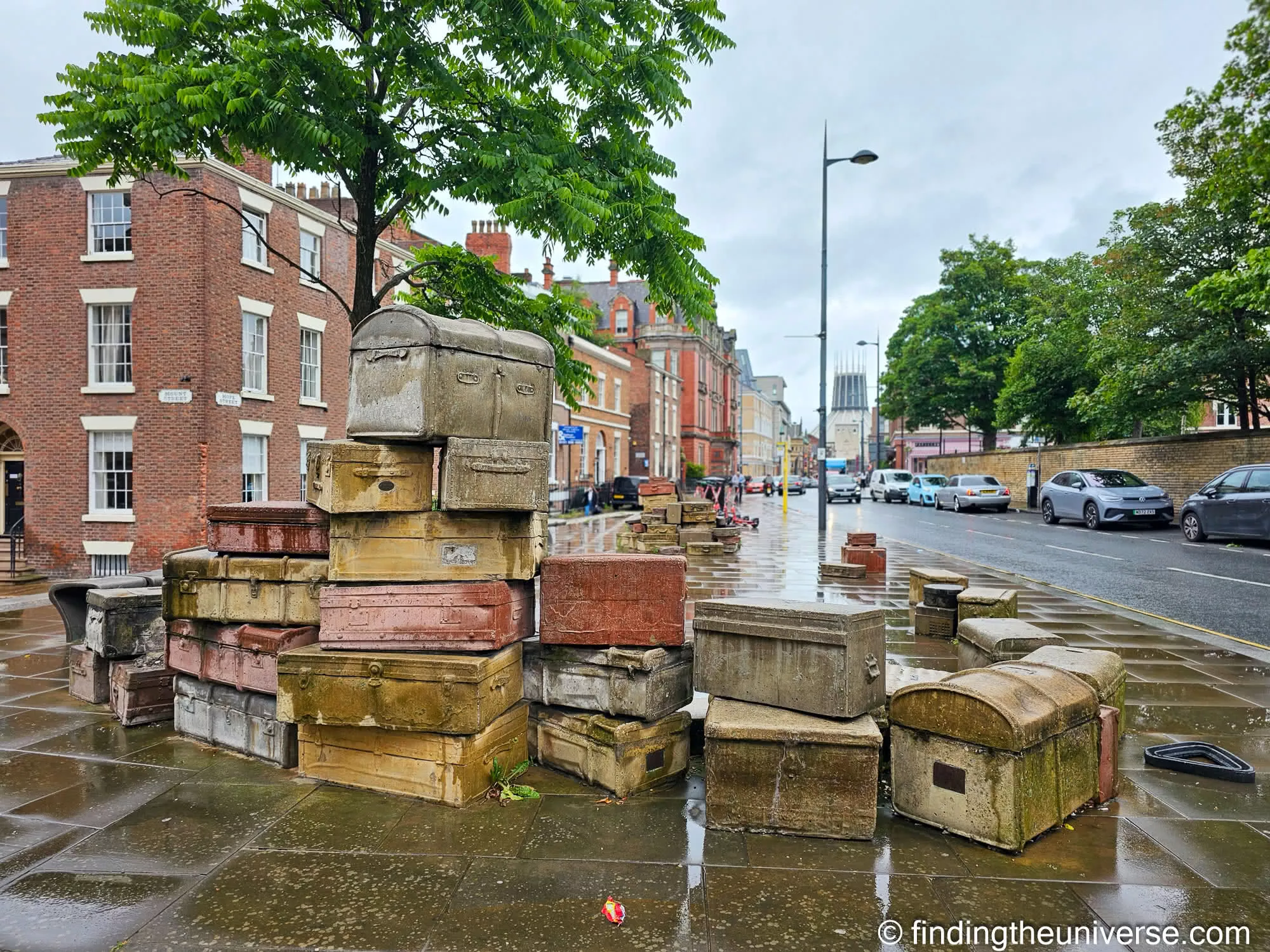
The Metropolitan Cathedral sits at one end of Hope Street, and Liverpool Cathedral sits at the other. The walk between the two front doors is half a mile, which takes 10 to 15 minutes, and it’s one of the best short walks in the country: Georgian terraces, the Philharmonic Hall, and a run of good pubs and restaurants the whole way.
This is the Georgian Quarter, and if you have spare time at the end of the day, come back and wander the side streets.
Liverpool Cathedral and the Tower
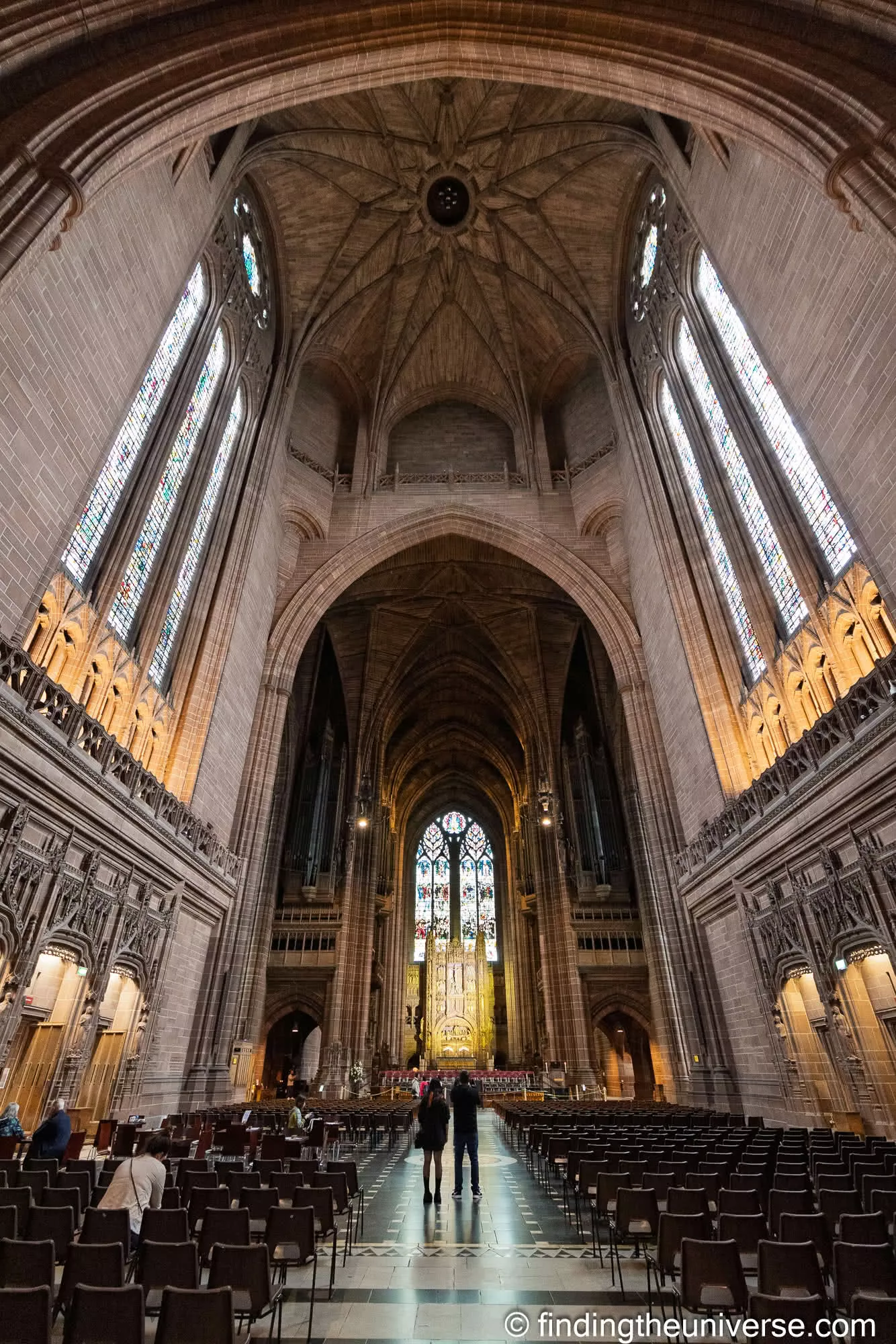
Liverpool Cathedral, the Anglican one, is at the southern end of Hope Street, and the scale of it is pretty hard to take in until you’re standing inside. It looks ancient. It was only completed in 1978, and my mum, who grew up in the city, remembers it being built. Entry is free.
The Tower Experience takes you up to the top for a view over the whole city and, on a clear day, well beyond it. Tickets are £8 for adults, £6.50 for concessions, and £22.50 for a family of two adults and up to three children.
It’s open Monday to Friday 10am to 5pm, Saturday 9am to 5pm, and Sunday 12pm to 4pm only, with last admission 30 minutes before closing. The tower also closes during bell-ringing (the cathedral publishes a bell ringing calendar), so if the tower is a priority, don’t leave it until the last window of your trip.
Afternoon and Evening: Bold Street, Liverpool ONE and the Baltic Triangle
From the cathedral, it’s about a 10 minute walk down to Bold Street, which is where I’d point you for lunch: it’s the city’s independent food street, and you’ll find something whatever your budget. From there you can shop your way through Liverpool ONE, or head into the Baltic Triangle, the former warehouse district that now holds the city’s more interesting bars and venues.
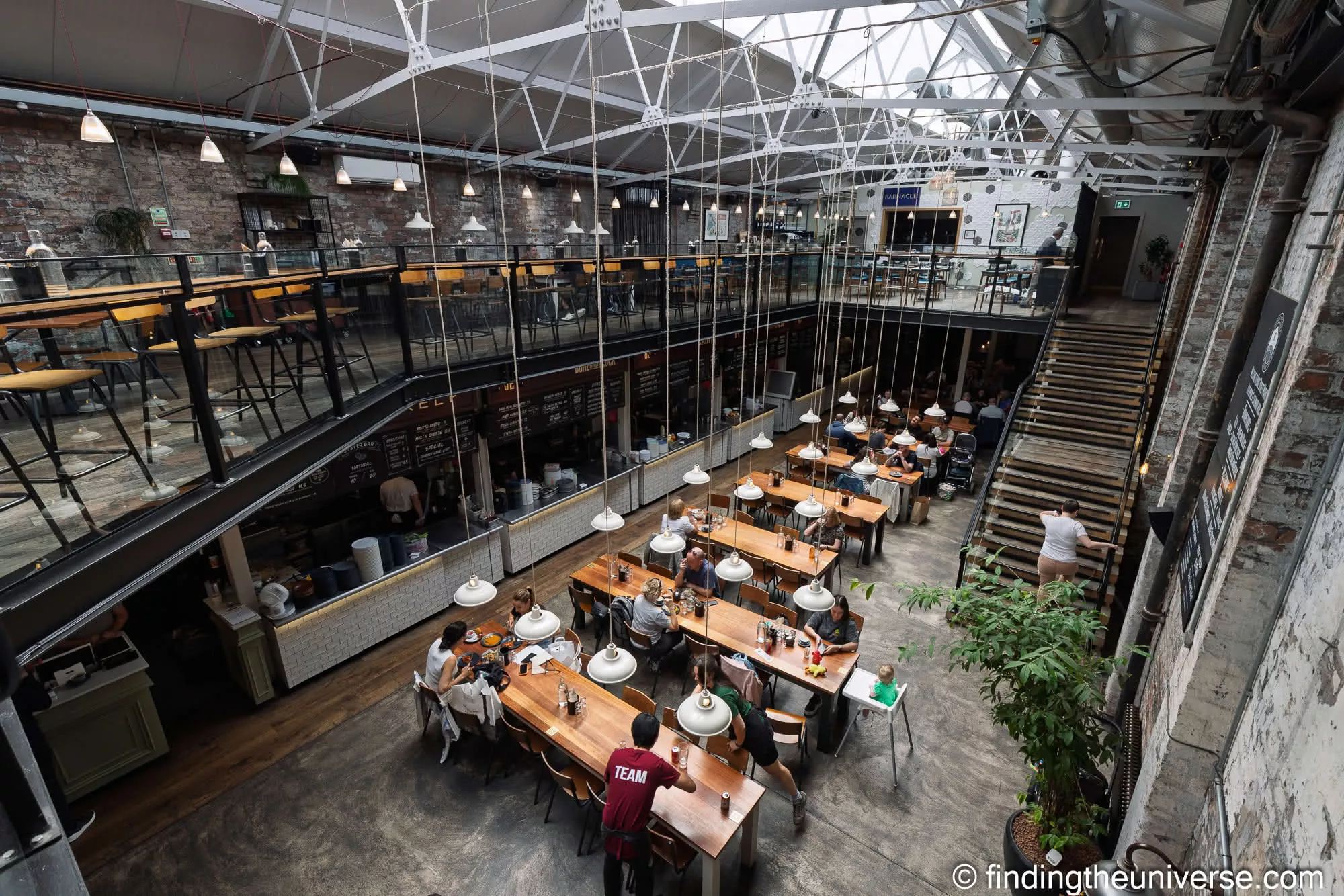
For the evening, my pick is the Duke Street Food and Drink Market, a food hall with six independent kitchens and a bar under one roof. We ate here on our last visit and it was the highlight of our eating in Liverpool: everyone gets what they want, nobody has to compromise, and the quality is a long way above what “food hall” might suggest.
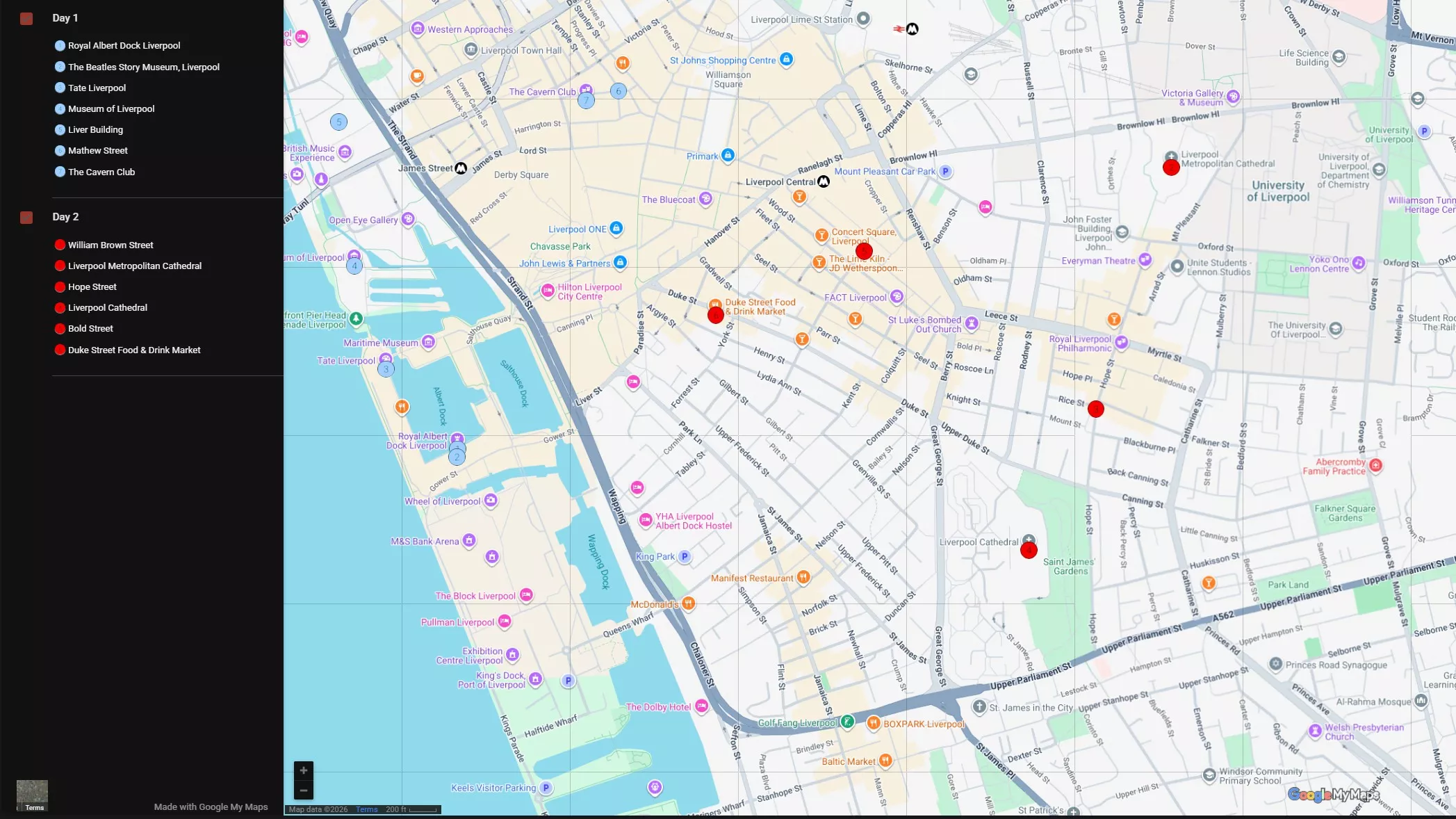
Map of This Liverpool Itinerary
Here’s a map of everything in this itinerary, with day one in one colour and day two in another. Click the map to open the interactive Google My Maps version, which you can save to your own phone for the trip.
The Anfield Option
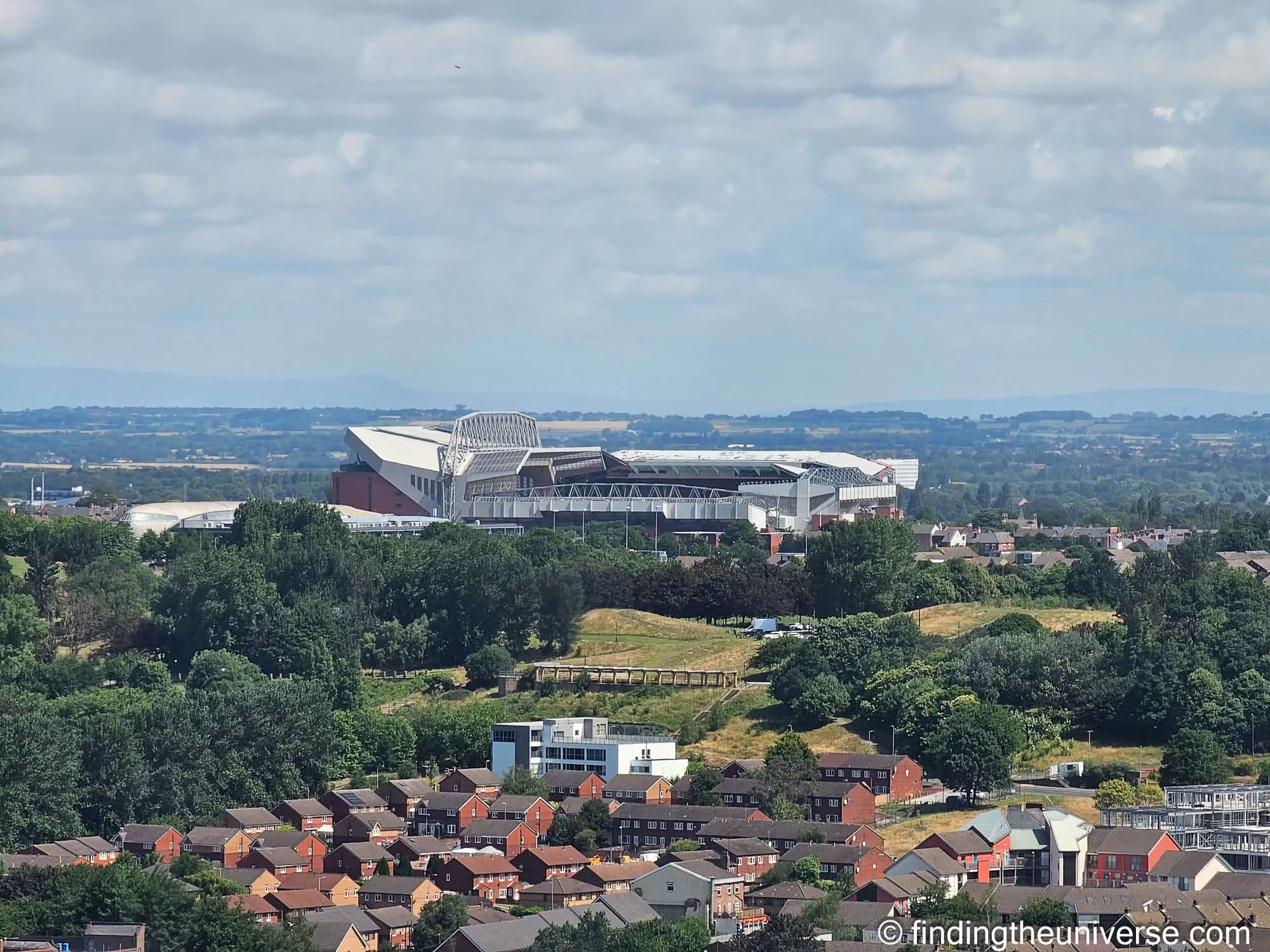
If you’re a football fan, you might want to swap the day two morning for Anfield, home of Liverpool FC. Full disclosure: we haven’t done this tour ourselves (we’ve visited a lot of stadiums over the years, and these days we save them for clubs that mean something to us), so this section is careful research rather than first-hand experience. For fans, though, it’s an easy recommendation.
The LFC Stadium Tour takes you through the dressing rooms, down the tunnel and pitchside, and lasts around 80 minutes, with the club museum adding another 30 minutes or so. Tours run seven days a week from 10am to 3pm.
Standard prices are £24 for adults, £18 for seniors and students, £14 for children, and £72 for a family of four, and it’s cheaper booked in advance. You can book the Anfield stadium tour here, or via the club’s own site.
On home match days the standard tour doesn’t run, but a Matchday Tour does, at £28 for adults, with the dressing rooms and press room excluded. Anfield also hosts big summer concerts, and tours pause around event days and their setup, so whenever you visit, check the booking calendar before you build a morning around it.
Getting there is the bit that catches people out. Search for a bus to Anfield and you’ll likely land on the 917 express. Don’t rely on it: it only runs on event days (home matches and concerts), starting a few hours before kick-off, and on an ordinary sightseeing day it isn’t running at all.
Instead take the 26 or 27 from Liverpool ONE bus station, or the 17 from Queen Square, both of which take 15 to 20 minutes. You’ll be back in the city centre for a late lunch, and you can pick day two back up at the cathedrals.
Only Have One Day in Liverpool?
If you’ve only got one day, here’s how I’d compress it. Spend the morning on the waterfront: walk the Royal Albert Dock, then choose between the Beatles Story and the Museum of Liverpool depending on whether music or the city itself interests you more. Walk Pier Head and the Three Graces around midday.
In the afternoon, walk up through the city centre to the Metropolitan Cathedral, along Hope Street, and finish at Liverpool Cathedral, going up the tower if the timings work (remember the Sunday window is 12pm to 4pm only). That’s the city’s two best areas in one day, connected by a walk you’d want to do anyway. It’s a full day, but not a silly one.
Arriving on a Cruise Ship
Liverpool’s cruise terminal is on the waterfront just north of Pier Head, which makes the one day plan above unusually cruise-friendly: you step off the ship more or less into the middle of it. If Liverpool is your embarkation port, it’s also well worth arriving a day early and staying the night before, both for the buffer and because you’ll actually get to see the city. The waterfront hotels below are the obvious pick for that.
Getting to Liverpool
Liverpool Lime Street is the main station, right in the city centre, with direct trains from London Euston, Manchester, Birmingham and most other major cities. Everything in this itinerary was written assuming you start from Lime Street, and the walking times reflect that.
Liverpool John Lennon Airport sits on the southern edge of the city, with regular buses into the centre. For long-haul arrivals, Manchester Airport is the more likely entry point, and it has direct trains to Liverpool.
If you’re coming from Manchester itself, the two cities pair well for a longer trip: see our 2 day Manchester itinerary for that half of the pairing. Liverpool also features as a stop on our 10 day UK itinerary by public transport, if you want to slot it into a bigger route.
Getting Around Liverpool
You won’t need much transport. The city centre is compact and flat, and every walk in this itinerary is 20 minutes or less. The longest single leg is Lime Street to the Royal Albert Dock at 15 to 20 minutes, and even that can be shortened with the Merseyrail loop: underground trains connecting Lime Street, Central, James Street and Moorfields, so you’re never more than a couple of minutes’ ride from the waterfront.
Buses fill in the gaps, mainly for Anfield (see above). Otherwise, comfortable shoes are the transport plan.
Where to Stay in Liverpool
A quick note first: when we visit Liverpool we normally stay with my godmother, so unlike most of this article, these picks come from research and reviews rather than nights slept in the rooms. The exception is the aparthotel point below. I’ve organised the picks by neighbourhood rather than by price, because in a city this walkable, where you wake up matters more than what you pay.
On our most recent trip we actually booked a Staycity aparthotel, because we were in the city for a couple of weeks and wanted an apartment rather than a hotel room. If you’re staying longer than a few nights, an aparthotel is the way to go here.
Royal Albert Dock and the Waterfront: Pullman Liverpool
If this itinerary appeals, the waterfront is the obvious place to sleep, and the Pullman Liverpool is the pick: a modern 4 star hotel at Kings Dock, a few minutes on foot from the Royal Albert Dock and the Beatles Story. You’ll pay a little more for the location, and it’s the right location to pay for.
Ropewalks: The Resident Liverpool
Ropewalks is the district between the city centre and the Baltic Triangle, and it’s where I’d stay for food and nightlife. The Resident Liverpool is the pick here: compact, well-reviewed rooms with mini-kitchens, a short stroll from both Bold Street and Duke Street Market.
Georgian Quarter and Hope Street: Hope Street Hotel
For the prettiest setting, the Hope Street Hotel puts you between the two cathedrals on the street I described earlier, surrounded by Georgian terraces and some of the city’s best restaurants. It’s the boutique option, and the one I’d pick for a special occasion.
City Centre: Ropewalks Hotel
For maximum convenience to everything, the Ropewalks Hotel (BW Premier Collection) is a solid central base near Liverpool ONE. And yes, the hotel called Ropewalks Hotel is my city centre pick rather than my Ropewalks pick. I didn’t name them, and I can only apologise on their behalf.
Where to Eat and Drink in Liverpool
I’ll keep this section shorter than most, because I’d rather tell you about places we’ve actually eaten than pad a list from other people’s reviews.
The one I’ll happily commit to is the Duke Street Food and Drink Market: six kitchens, one bar, one roof, and the best meal we had on our last visit. It’s the answer to the eternal group-travel problem of nobody agreeing on a cuisine.
Beyond that, trust the areas rather than specific picks: Bold Street for independent lunch spots, Hope Street and the Georgian Quarter for restaurants and proper old pubs (the Philharmonic Dining Rooms is the famous one), the Baltic Triangle for bars and evening venues, and the Cavern Quarter for live music with your pint. Liverpool is not a city where you’ll struggle to eat well.
When to Visit Liverpool
Liverpool works year-round, but the seasons change the maths. In midsummer it stays light until nearly 10pm, which gives you enormous, unhurried days. In midwinter you get barely seven and a half hours of daylight, so the same itinerary means doing the outdoor walking in a much tighter window and saving museums for the dark ends of the day.
Summer has one more thing going for it: the school holidays mean the free museums open on Mondays. The trade-off is crowds at the Beatles sights, which is why I keep saying to book the timed-entry attractions ahead.
One more seasonal note: this is a football city. If your dates coincide with a big home fixture, hotels fill up and the Anfield area transforms, so check the fixture list when you book, whichever side of that you want to be on.
Things to Double-Check Before You Go
To pull the traps from everywhere above into one place, here’s what most often trips up a Liverpool plan.
The big one is the waterfront museums. The Maritime Museum and International Slavery Museum are closed until 2029, so don’t build a day around them. And on Mondays outside school holidays the free national museums are closed too, with the Tate at RIBA North (open every day) as your reliable fallback.
Watch the tower windows. Liverpool Cathedral’s tower runs 12pm to 4pm on Sundays, a much shorter window than the rest of the week, and it closes during bell-ringing.
At Anfield, standard tours don’t run on home match days (a reduced Matchday Tour does), and summer concerts pause tours entirely, so check the booking calendar before you commit a morning to it. The Beatles Story sells timed slots and doesn’t take cash, and RLB360 has no fixed timetable and sells out at peak times, so book both ahead.
Frequently Asked Questions About Visiting Liverpool
Is 2 days enough for Liverpool?
Yes, two days is enough for a first visit. You can cover the Royal Albert Dock, the Beatles Story, Pier Head and the free museums on day one, and the two cathedrals, Hope Street and the Georgian Quarter on day two, all on foot.
If you want to add the Anfield stadium tour or a day trip to Chester, a third day stops things feeling rushed, but two well-planned days cover the headline sights.
Is the Maritime Museum in Liverpool open?
No. The Merseyside Maritime Museum and the International Slavery Museum have both been closed since January 2025 for a major redevelopment, and they’re not due to reopen until 2029.
The other National Museums Liverpool venues in the city centre (the Museum of Liverpool, Walker Art Gallery and World Museum) remain open and free, and Tate Liverpool is open at RIBA North on Mann Island.
Are Liverpool’s museums free?
The national museums are, yes. The Museum of Liverpool, Walker Art Gallery and World Museum are all free, as is Tate Liverpool at RIBA North, and both cathedrals are free to enter.
The paid attractions are the Beatles Story (£20 adults), the cathedral Tower Experience (£8), Royal Liver Building 360 (£18.50) and the Anfield tour (£24), so a two day trip can run from completely free to fairly spendy depending on your picks.
Are Liverpool museums open on Mondays?
The free national museums close on Mondays except during school holidays, when they open seven days a week. Outside the holidays, check the day you’re going.
Tate Liverpool at RIBA North is open every day including Mondays, as are the Beatles Story and both cathedrals, so a Monday in Liverpool is still a full day.
How do you get to Anfield from Liverpool city centre?
Take the 26 or 27 bus from Liverpool ONE bus station, or the 17 from Queen Square. Both take 15 to 20 minutes.
Don’t plan around the 917 express: it only runs on event days such as home matches and concerts, so on a normal sightseeing day it won’t be running at all.
What’s the best day trip from Liverpool?
Chester. It’s a direct Merseyrail train on the Wirral Line, takes about 45 minutes, and runs every 15 minutes Monday to Saturday, so you don’t even need to plan around a timetable.
We’ve written a full guide to spending a day in Chester, covering the Roman walls, the Rows and whether the city is worth your time (it is).
Further Reading
That should be everything you need to plan a couple of days in Liverpool. Here are some of our other guides to help with the rest of a northern England trip:
- 2 Days in Manchester: The Perfect Manchester Itinerary
- One Day in Chester: Is It Worth Visiting?
- A 10 Day UK Itinerary by Public Transport
- Unmissable English Cities to Visit
As always, if you’ve got questions about planning your own Liverpool trip, pop them in the comments below and we’ll do our best to help!














 English (US) ·